Can the number of senators change?
Yes, the number of senators can change. In fact, the number of senators has increased 3 times – in 1948, 1974 and 1983.
Section 7 of the Australian Constitution gives Parliament the power to decide how many senators there are by passing a bill, although there are conditions. The Constitution says that:
- the original states (New South Wales, Victoria, Queensland, South Australia, Western Australia and Tasmania) must have the same number of senators
- the original states must have at least 6 senators.
When the Senate first met in 1901 there were 36 senators – 6 from each state.
In 1948, Parliament passed a law increasing the number of senators for each state from 6 to 10. In 1983, Parliament again passed a bill increasing that number from 10 to 12.
Section 122 gives the Australian Parliament the power to decide how many, if any, senators a territory may have. In 1974, Parliament passed the Senate (Representation of Territories) Act 1973 which allowed the Australian Capital Territory (ACT) and the Northern Territory (NT) to be represented by 2 senators each.
Today, there are 76 senators. There are 12 senators from each state and 2 senators each from the ACT and NT.
A related rule in the Constitution is found in section 24, sometimes known as the ‘nexus provision’. This section requires that the number of members of the House of Representatives must be as near as possible to twice the number of senators. This means any change to the number of senators will have an impact on the number of members in the House of Representatives.
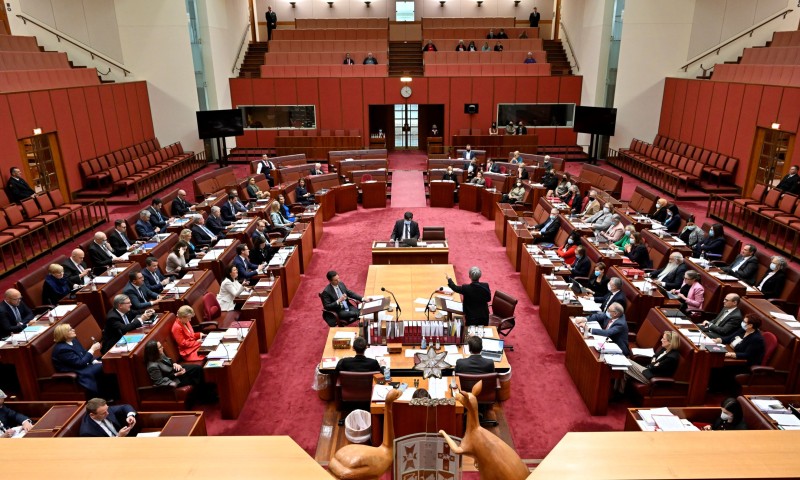
The Senate from behind the President of the Senate's chair
DPS Auspic
The Senate from behind the President of the Senate's chair
DPS Auspic
Description
The Senate is a large room with red furnishings. Seats and desks for senators are arranged in a horse-shoe shape around a large central table.
Permission should be sought from DPS AUSPIC for third-party or commercial uses of this image. To contact DPS AUSPIC email: auspic@aph.gov.au or phone: 02 6277 3342.