Senators
Discover the work of senators in this fact sheet. It explores their role in the Australian Parliament and in the community, their working hours and period of service.
What will I learn?
- A person elected to the Senate is called a senator.
- Senators are elected by Australian citizens to represent a state or a territory.
- Senators work in Parliament and in their community.

What is a senator?
A senator is someone who has been elected to represent their state or territory in the Senate. There are 76 senators. Each state is represented by 12 senators, and the Northern Territory and Australian Capital Territory are represented by 2 senators each. Senators can be members of the government, opposition or be on the crossbench. Their work takes place both in Parliament House in Canberra and in the state or territory they represent. The Senate from behind the President of the Senate's chair DPS Auspic DPS Auspic The Senate is a large room with red furnishings. Seats and desks for senators are arranged in a horse-shoe shape around a large central table. Permission should be sought from DPS AUSPIC for third-party or commercial uses of this image. To contact DPS AUSPIC email: auspic@aph.gov.au or phone: 02 6277 3342.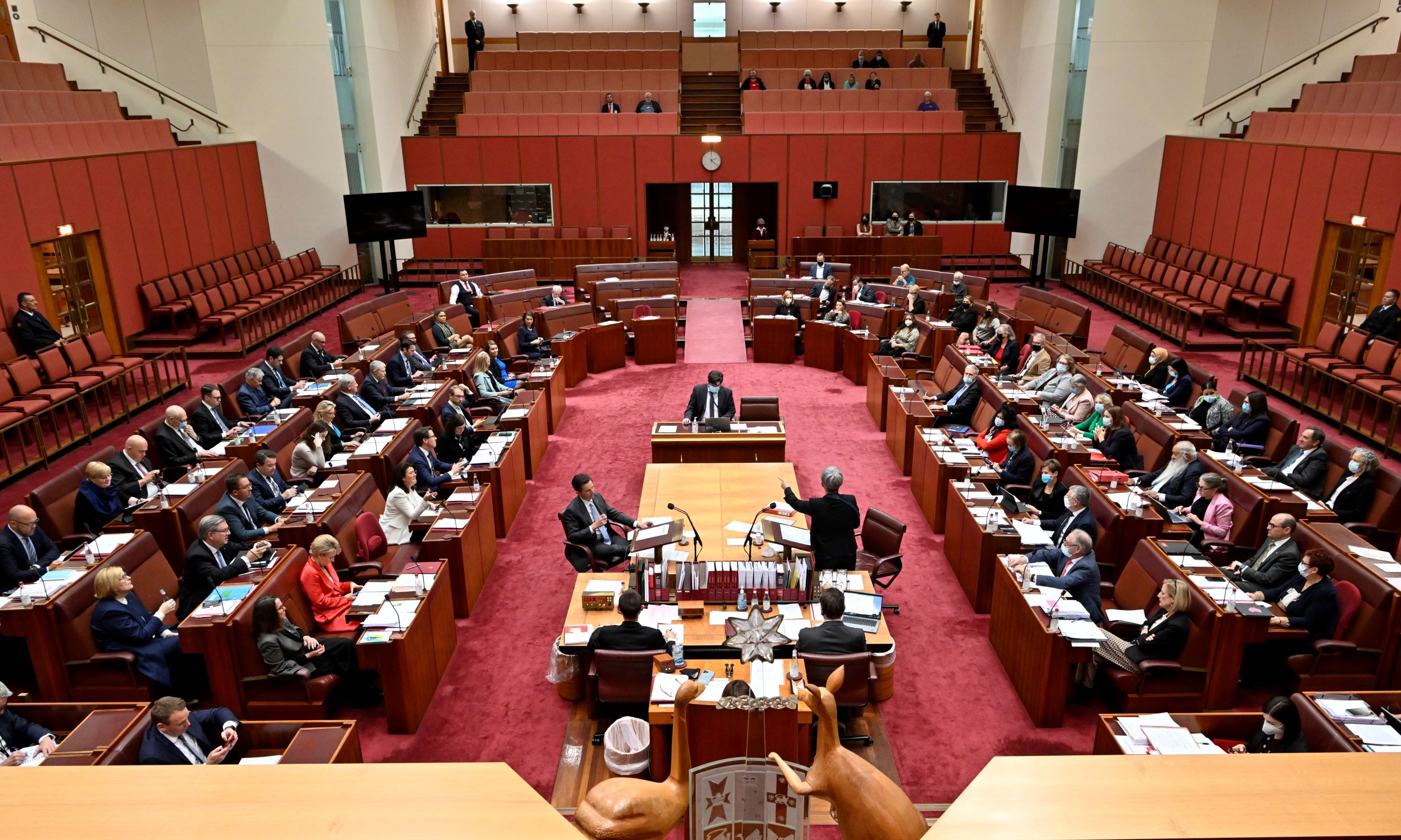
The Senate from behind the President of the Senate's chair
Description
Copyright information
Work of senators in Parliament House
Senators work long hours when the Parliament is meeting. During sitting weeks, senators may begin their day in Parliament House at 7am and end their day at 10pm or later. There are around 18 to 20 sitting weeks a year. In Parliament their duties include:
- representing the views of the people of their state or territory
- debating and voting on bills – proposed laws
- examining issues by working on committees
- meeting with team members to decide on policies
- scrutinising – closely examining – the work of the government
- discussing issues of national and international importance.
Work of senators in their state or territory
When Parliament is not sitting, senators spend much of their time working in the state or territory they represent. They:
- work on committees to collect information from people and groups that want to present their views to Parliament, such as community organisations or lobby groups
- help people who may be having difficulties with issues such as taxes, immigration, health or social services
- meet with community groups such as pensioner associations, support groups and sporting clubs
- visit schools and talk to teachers and students.
Some senators have extra responsibilities, such as being the leader of their political party or a minister or shadow minister, which may require them to spend time travelling around Australia.
Period of service
State senators are elected for a period of 6 years with their re-election occurring on a rotational basis. This means that every 3 years half of the state senators are up for re-election while the other half continue on to complete their period of service. At the end of their 6-year term, this group of senators will face re-election. These half-Senate elections are usually held at the same time as elections for the House of Representatives.
Senators representing the Australian Capital Territory and the Northern Territory have 3-year terms which are the same as for members of the House of Representatives.
Senators can stand for re-election as many times as they like.
What senators do in the Australian Parliament
Tap on the icons to explore the work that senators do in Parliament and their state or territory.










Images: Paul Furness/DPS AUSPIC, Kate Ausburn, Geoffrey Dunn/DPS AUSPIC, The Office of the Prime Minister, Penny Bradfield/DPS AUSPIC, David Foote/DPS AUSPIC.