Curriculum links – Year 8
The PEO has a range of resources to assist teachers in their delivery of the content descriptions for the Year 8 Civics and Citizenship learning area in the Australian Curriculum V9.0.
Individual curriculum linked resources
-
AC9HC8K01
-
How Australians are informed about and participate in democracy
-
Parliament House program
Join in the fun – and the learning – with the PEO's immersive learning program at Australia's Parliament House in Canberra. This free program is suitable for primary and secondary students.
-
Four key ideas of Australian democracy
This graphic illustrates the 4 supporting ideas of Australian democracy.
image
-
Getting involved in Parliament
This fact sheet explores some of the ways that Australians can get involved in the Australian Parliament. It includes information on elections, contacting members of parliament, committees and protesting.
Fact sheet
-
One voice for many
This video explores representation. It can be used as a visual aid in discussing representation with students.
video
-
Create your own electorate
Explore the role of members of parliament and how they represent communities around Australia.
Classroom activity page
-
Federal elections
This fact sheet explores how federal elections are used to select representatives in the Australian Parliament. It covers the process of electing senators and members of the House of Representatives.
Fact sheet
-
Role-play the Parliament: Committee
This video demonstrates a committee role-play, where students can learn how the Australian Parliament investigates bills and issues. It outlines lesson content and what preparation is required to use this immersive learning strategy in a classroom.
video
-
Getting involved
Explore the ways you can have your say and contribute to the work of the Australian Parliament. From voting to petitions, contacting members of parliament to protesting, there are many ways Australians can have their voice heard in Parliament.
-
Petitions
Petitions ask the Australian Parliament to act on an issue. This fact sheet explains the rules petitions must follow and how petitions are presented to the Parliament.
Fact sheet
-
Run an election campaign
Experience an election campaign in your classroom by analysing political advertisements and then developing your own campaigns!
Classroom activity page
-
Get involved
Explore ways you can get involved in the work of Parliament with this in-depth video. Find out how you can get informed about the work of the Parliament, contact and vote for members of parliament, petition the Parliament and participate in parliamentary inquiries.
video
-
Committees
Parliamentary committees investigate issues and proposed laws in detail. This fact sheet explains the role of committees, how they work and the types of committees in the Australian Parliament.
Fact sheet
-
Start a petition
Get involved and have your say by starting a petition. This activity can be used to help students have their voices heard in their school, local community, or in Parliament.
Classroom activity page
-
Year 8
This unit of work explores 5 topics aligned to the Year 8 Australian Civics and Citizenship Curriculum.
Classroom activity page
-
Run a parliamentary committee
Explore how individuals and communities can assist the Australian Parliament to investigate bills and important issues by running a parliamentary committee with your class.
Classroom activity page
-
Write a committee submission
Get involved in Australia’s Parliament by investigating current parliamentary committees and writing a submission!
Classroom activity page
-
Preferential voting
Discover why preferences matter on election day with the ABC’s Behind the News.
video
-
Preferential voting example
This graphic illustrates the process of distributing votes to elect a member in the House of Representatives.
image
-
Federal elections quiz
Find out how much you know about the election process with this fun quiz.
quiz
-
Parliamentary committees
Explore the function of committees and how they support the work of the Australian Parliament with this explanatory video.
video
-
Press gallery
Understand the role of the press gallery and its relationship with members of parliament and the public with this fact sheet.
Fact sheet
-
The role of the media quiz
How much do you know about the role the media plays in the Australian Parliament?
quiz
-
-
AC9HC8K02
-
The role of political parties and independent representatives in Australian democracy, including elections and the formation of governments.
-
Parliament House program
Join in the fun – and the learning – with the PEO's immersive learning program at Australia's Parliament House in Canberra. This free program is suitable for primary and secondary students.
-
Senate current numbers
This image shows the current numbers in the Senate.
image
-
Minor parties
Learn about the role of minor parties in the Australian Parliament with this fact sheet. Find out how minor parties can hold the balance of power and influence a hung parliament.
Fact sheet
-
House of Representatives current numbers
This image shows the numbers in the House of Representatives.
image
-
How to form a political party
This graphic shows the steps required to form a political party in Australia.
image
-
One voice for many
This video explores representation. It can be used as a visual aid in discussing representation with students.
video
-
Self-paced interactive learning
Whether you're new to teaching civics, a seasoned educator, a pre-service teacher, or a curriculum leader – our free, self-paced, interactive courses are designed for you.
-
Create your own electorate
Explore the role of members of parliament and how they represent communities around Australia.
Classroom activity page
-
Forming the Australian Government quiz
How much do you know about how the Australian Government is formed?
quiz
-
Create political parties
Investigate how the party system operates in Australia by creating your own political parties.
Classroom activity page
-
Federal elections
This fact sheet explores how federal elections are used to select representatives in the Australian Parliament. It covers the process of electing senators and members of the House of Representatives.
Fact sheet
-
Run an election campaign
Experience an election campaign in your classroom by analysing political advertisements and then developing your own campaigns!
Classroom activity page
-
The House of Representatives
Discover the role and work of the Australian House of Representatives with this introductory video.
video
-
The Senate
Discover the role and work of the Australian Senate with this introductory video.
video
-
Government
Investigate how the Australian Government is formed and its role in leading the nation.
-
What is Parliament?
Discover the structure and key functions of the Australian Parliament with this short video. It introduces the Parliament’s roles of law-making, representing Australians, the formation of government and checking the work of the government.
video
-
Negotiate a minority government
Role-play a high stakes parliamentary negotiation in order to learn how government is formed in a hung parliament.
Classroom activity page
-
Australian Parliament quiz
Test your understanding of the history, make-up and people of the Australian Parliament with this quick quiz.
quiz
-
Year 8
This unit of work explores 5 topics aligned to the Year 8 Australian Civics and Citizenship Curriculum.
Classroom activity page
-
Opposition
Get to know the opposition—the largest non-government team in the Australian Parliament.
-
Forming the Australian government
The Australian Government is formed after a federal election
-
Independents
This fact sheet explores the role of the independents and how they can vote in the Parliament.
Fact sheet
-
The Senate
Discover the people who work in the Senate with this interactive poster. Highlight the groupings of senators and test yourself on who sits where.
interactive
-
Political parties
In this fact sheet, learn more about why political parties exist, how they are formed and how they are organised.
Fact sheet
-
Choosing senators
Discover who represents us in the Senate and how they are chosen with this interative poster.
interactive
-
The role of political parties quiz
Test your knowledge of political parties in the Australian Parliament with this fun quiz.
quiz
-
The House of Representatives
Discover the people who work in the House of Representatives with this interactive poster. Highlight the groupings of members and test yourself on who sits where.
interactive
-
Choosing members
Discover who represents us in the House of Representatives and how they are chosen with this interative poster.
interactive
-
Forming the Australian government
Find out how the Australian government is formed and who makes up the Executive with this interactive poster.
interactive
-
-
AC9HC8K03
-
The characteristics of laws and how laws are made in Australia through parliaments (statutory law) and through the courts (common law).
-
Role-play the Parliament: House of Representatives
This video demonstrates a House of Representatives parliamentary role-play, where students can learn how new laws are made in the Australian Parliament. It outlines lesson content and what preparation is required to use this immersive learning strategy in a classroom.
video
-
Self-paced interactive learning
Whether you're new to teaching civics, a seasoned educator, a pre-service teacher, or a curriculum leader – our free, self-paced, interactive courses are designed for you.
-
Role-play the Parliament: Senate
This video demonstrates a Senate parliamentary role-play, where students can learn how new laws are made in the Australian Parliament. It outlines lesson content and what preparation is required to use this immersive learning strategy in a classroom.
video
-
Make a law: House of Representatives
Discover how bills - proposed laws - are introduced, debated and voted on in the House of Representatives by turning your class into a Parliament and doing it yourselves.
Classroom activity page
-
Parliament, Executive and Judiciary
Explore how the power to make and manage law is shared in Australia with this interactive. It can be used in the classroom to illustrate the separation of powers.
interactive
-
Role-play the Parliament: the role-play in action
This video shows a snapshot of a parliamentary role-play in the Education Centre at Australia’s Parliament House.
video
-
Law-making
This fact sheet explains the law-making process in the Australian Parliament. It also describes where ideas for laws come from and the history of law-making in the Parliament.
Fact sheet
-
Make a law: Senate
Discover how bills – proposed laws – are introduced, debated and voted on in the Senate by turning your class into a Parliament and doing it yourselves!
Classroom activity page
-
Committees
Parliamentary committees investigate issues and proposed laws in detail. This fact sheet explains the role of committees, how they work and the types of committees in the Australian Parliament.
Fact sheet
-
Making a law
Get an introduction to the law-making process of the Australian Parliament with this short video.
video
-
Year 8
This unit of work explores 5 topics aligned to the Year 8 Australian Civics and Citizenship Curriculum.
Classroom activity page
-
The usual path of a bill
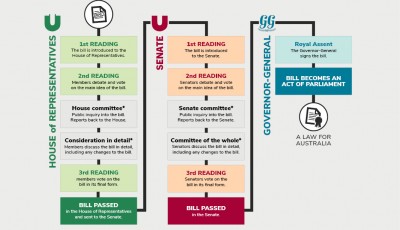
This graphic illustrates the usual path of a bill through the Australian Parliament to become Australian law.
image
-
Parliament and the courts
This fact sheet outlines the relationship between the Australian Parliament and federal courts, including the separation of powers and key High Court of Australia cases that have impacted the powers of the Australian Parliament.
Fact sheet
-
Bills and laws quiz
Revise your study of law-making with this quiz.
quiz
-
Write a committee submission
Get involved in Australia’s Parliament by investigating current parliamentary committees and writing a submission!
Classroom activity page
-
Rights
On this fact sheet, find out about where rights in Australia come from, types of rights and how rights are considered when Parliament makes laws.
Fact sheet
-
Rights in Australia
This paper investigates the framework of rights in Australia. It defines the different types of rights, including human rights, and looks at the sources for our rights.
inFocus
-
Pass the bill
This interactive details each step of the law-making process in the Australian Parliament. Users follow the progress of a bill to lower the voting age to 16 through the Australian Parliament. Perfect for use in the classroom.
interactive
-
Amendments
An amendment is a change to a proposed law. Amendments are an important part of the law-making process in the Australian Parliament. This fact sheet outlines the amendment process.
Fact sheet
-
Separation of powers: Parliament, Executive and Judiciary
The separation of powers distributes the power to govern between the Parliament, the Executive and the Judiciary. This fact sheet examines the powers of each group and the related principle of responsible government.
Fact sheet
-
Sources of law
This fact sheet introduces the different ways law is made Australia – statute law made by parliament, delegated law made by the Executive government and common law made in courts.
Fact sheet
-
Delegated law
Delegated law gives government ministers and others the power to make decisions about the details of laws passed by the Australian Parliament. This fact sheet explains how regulations and other types of delegated law are made and overruled.
Fact sheet
-
Separation of powers quiz
Test your knowledge of the separation of powers—an important principle of Australia's democracy.
quiz
-
Sources of law quiz
Test your recollection of the ways that law is made in Australia—statute, common and delegated
quiz
-
Parliamentary committees
Explore the function of committees and how they support the work of the Australian Parliament with this explanatory video.
video
-
Making Australian law
Understand the process of making a law in the Australian Parliament with this interactive poster.
interactive
-
-
AC9HC8K04
-
The types of law in Australia, including criminal law and civil law, and the place of First Nations Australian customary law.
-
Year 8
This unit of work explores 5 topics aligned to the Year 8 Australian Civics and Citizenship Curriculum.
Classroom activity page
-
Sources of law
This fact sheet introduces the different ways law is made Australia – statute law made by parliament, delegated law made by the Executive government and common law made in courts.
Fact sheet
-
Delegated law
Delegated law gives government ministers and others the power to make decisions about the details of laws passed by the Australian Parliament. This fact sheet explains how regulations and other types of delegated law are made and overruled.
Fact sheet
-
Sources of law quiz
Test your recollection of the ways that law is made in Australia—statute, common and delegated
quiz
-
-
AC9HC8K05
-
How culture and religion may influence individuals' and groups' perceptions and expressions of citizenship and their actions as citizens.
-
AC9HC8K06
-
Different experiences of, perspectives on and debates about Australia’s national identity and citizenship, including the perspectives of First Nations Australians as owners of their respective nations, and of different migrant groups.
-
National symbols in Parliament House
This fact sheet gives details about some of Australia's national symbols and where they are featured in Australian Parliament House. It explains the history and significance of Australia’s Coat of Arms, flags and floral emblem.
Fact sheet
-
Year 8
This unit of work explores 5 topics aligned to the Year 8 Australian Civics and Citizenship Curriculum.
Classroom activity page
-
Discover more Year 8 curriculum-aligned resources
For content to deliver the Year 8 Civics and Citizenship skills, discover our range of Classroom activities, print resources and quizzes.
Source information
Australian Curriculum, Assessment and Reporting Authority (ACARA) Version 9.0 Home | V9 Australian Curriculum.
Last accessed January 2026.