Petitions
Petitions ask the Australian Parliament to act on an issue. This fact sheet explains how petitions can draw attention to an issue are how they are presented to Parliament.
What will I learn?
- A petition is a request for the Parliament to act to solve a problem.
- There are rules about how petitions should be written and presented to Parliament.
- Petitions can be made by anyone.

What is a petition?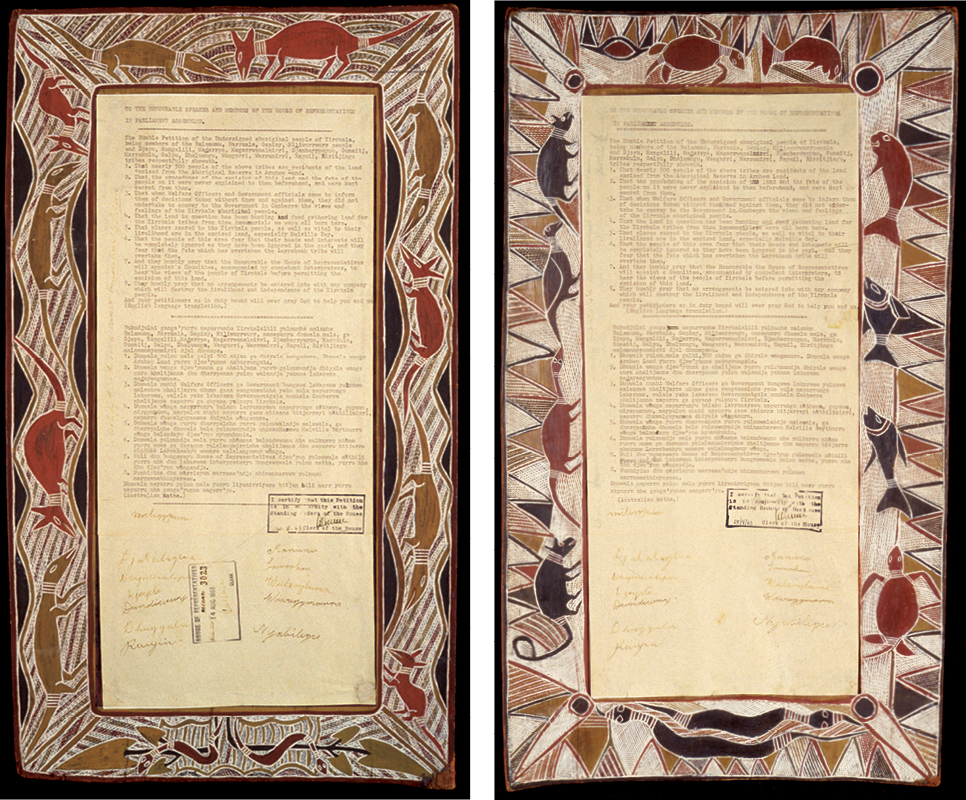
The Yirrkala petitions. Yirrkala artists, Dhuwa moiety, 14 August 1963 Yirrkala artists, Yirritja moiety, 28 August 1963
House of Representatives, Canberra
The Yirrkala petitions. Yirrkala artists, Dhuwa moiety, 14 August 1963 Yirrkala artists, Yirritja moiety, 28 August 1963
House of Representatives, Canberra
Description
These petitions were sent from Yirrkala, Northern Territory to the House of Representatives in 1963.The petitions are on 2 large rectangular pieces of bark. Each has a border decorated with traditional iconography of animals including turtles, snakes and fish. Inside each decorated border is a piece of paper with typed words, followed by handwritten signatures and stamps. The petitions have typed text in both Yolngu Matha and English.
Copyright information
Permission for publication should be sought from the House of Representatives Table Office at Table.Office.Reps@aph.gov.au
The Yirrkala petitions. Yirrkala artists, Dhuwa moiety, 14 August 1963 Yirrkala artists, Yirritja moiety, 28 August 1963
House of Representatives, Canberra
The Yirrkala petitions. Yirrkala artists, Dhuwa moiety, 14 August 1963 Yirrkala artists, Yirritja moiety, 28 August 1963
House of Representatives, Canberra
Description
These petitions were sent from Yirrkala, Northern Territory to the House of Representatives in 1963.The petitions are on 2 large rectangular pieces of bark. Each has a border decorated with traditional iconography of animals including turtles, snakes and fish. Inside each decorated border is a piece of paper with typed words, followed by handwritten signatures and stamps. The petitions have typed text in both Yolngu Matha and English.
Copyright information
Permission for publication should be sought from the House of Representatives Table Office at Table.Office.Reps@aph.gov.au
A petition is a request by a group of citizens for Parliament to act to solve a problem. A petition is a written statement or request, followed by a list of names of people who support it.
Citizens can directly ask Parliament to take action through a petition. There is no age restriction on who can start or sign a petition, so petitions are a way for anyone to draw attention to a concern. The Australian Parliament receives many petitions each year on a wide range of subjects.
Preparing and presenting petitions to Parliament
Preparing a petition involves writing a clear request and gathering support by collecting the names of people who agree. If there are many names, it shows there is a lot of support for the request. A petition is made to either the Senate or the House of Representatives. Both have rules that must be followed for a petition to be accepted and presented. To be accepted, a petition must follow the rules for petitions in the Senate or House standing orders.
They must:
- contain a request for action in an area the Australian Parliament has the power to make laws
- use respectful language
- be formally presented by a senator or member.
If a petition meets the rules, it will be presented by a senator or member of the House of Representatives, even though they may not agree with the request.
Impact of petitions
Petitions help draw the attention of members of parliament to issues that people care about. When a petition is presented to Parliament, it becomes part of the official record. The words of the petition and number of signatures are printed in Hansard. A petition may be sent to the minister responsible for the issue so they can consider it. A minister may respond, the petition may be discussed in Parliament or the issue may be investigated by a committee.
For example, one of the most famous petitions in the Australian Parliament was presented to the House of Representatives in 1963. The Yolgnu people of Yirrkala in the Northern Territory requested that Parliament recognise their traditional land on the Gove Peninsula in Arnhem Land, which was under threat from mining. This petition combined bark painting, words in English and Yolgnu, and Aboriginal designs. As a result of the Yirrkala Petition, the Parliament established a committee to investigate the issue. The petition helped bring national attention to Aboriginal and Torres Strait Islander land rights.
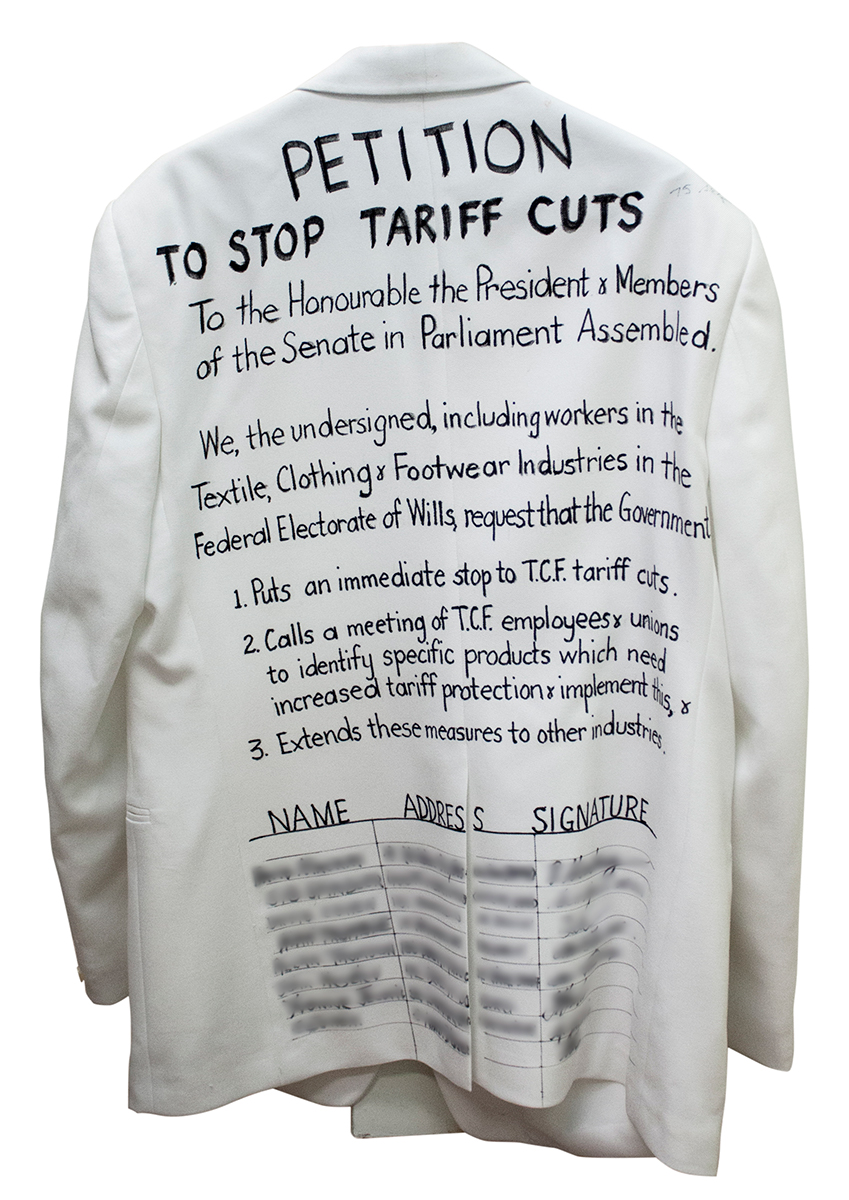
Petition presented in the Australian Senate to stop tariff cuts
The Department of the Senate
Petition presented in the Australian Senate to stop tariff cuts
The Department of the Senate
Description
This is a photo of the back of a white dinner jacket which has been written on in black marker. The jacket was presented to the Senate as a petition on 2 April 1992. The writing says:
‘PETITION TO STOP TARIFF CUTS To the Honourable the President and Members of the Senate in Parliament Assembled. We, the undersigned, including workers in the Textile, Clothing & Footwear Industries in the Federal Electorate of Wills, request that the Government: 1. Puts an immediate stop to TCF tariff cuts. 2. Calls a meeting of TCF employees & unions to identify specific products which need increased tariff protection and implement this. 3. Extends these measures to other industries.’
This is followed by a table with the following headings: Name, Address and Signature. The signatures have been blurred out for the photo.
History
The right to petition the monarch and parliament to solve a problem dates back to the 13th century in Britain. At that time, proposed laws – bills – were little more than petitions to the monarch. Petitions in their current form date from the 17th century.
Petitions have been an accepted practice of the Australian Parliament since it was established in 1901. For most of that history, petitions were written on paper. Today, many are submitted online. In some cases, people have used other ways to show support for a request. In 1992, a petition about the textile, clothing and footwear industries was written on a jacket and presented to the Senate.
