Why do senators sometimes move motions that they know will fail?
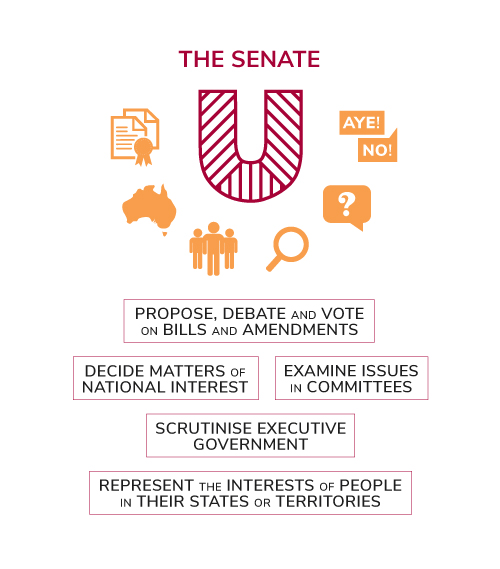
Role of the Senate
Parliamentary Education Office (peo.gov.au)
Role of the Senate
Parliamentary Education Office (peo.gov.au)
Description
The Senate:
- decides matters of national interest
- represents the interests of people in their states or territories
- proposes, debates and votes on bills and amendments
- examines issues in committees
- scrutinises executive government.

This work is licensed under a Creative Commons Attribution-NonCommercial-NoDerivatives 4.0 International License.
You are free to share – copy and redistribute the material in any medium or format.
The licensor cannot revoke these freedoms as long as you follow the license terms.
Attribution – You must give appropriate credit, provide a link to the license, and indicate if changes were made. You may do so in any reasonable manner, but not in any way that suggests the licensor endorses you or your use.
Non-commercial – You may not use the material for commercial purposes.
No derivatives – If you remix, transform, or build upon the material, you may not distribute the modified material.
No additional restrictions – You may not apply legal terms or technological measures that legally restrict others from doing anything the license permits.
Waiver – any of the above conditions can be waived if you get permission from the copyright holder.
Thanks for your question!
Senators are elected by the people in their state or territory to represent them in the Senate. Senators discuss state, territory and national issues, debate and vote on bills – proposed laws – and scrutinise – closely examine – the work of the Australian Government. To do this, they sometimes need to move a motion – an idea put forward for consideration, debate and decision.
The purpose of moving a motion may be to allow different topics to be heard and discussed in the Senate. It also allows senators to speak up about the concerns and views of the people in their state or territory. Although senators may know a motion will fail because a majority of senators do not support it, it is still seen as an important part of the process of representation, law-making and scrutinising government decisions. These are all important roles of the Australian Parliament.