Who decides the question for a referendum?
Thank you for your question, Jeff!
The Australian Parliament decides on the question that will be put to Australian voters in a referendum.
The question starts as a bill that is introduced by a member of parliament. If the bill is agreed to by an absolute majority in both the House of Representatives and the Senate, the proposal must be presented to Australian voters in a referendum. The wording of the question that will appear on the referendum ballot paper comes from the long title of the bill that parliament has approved.
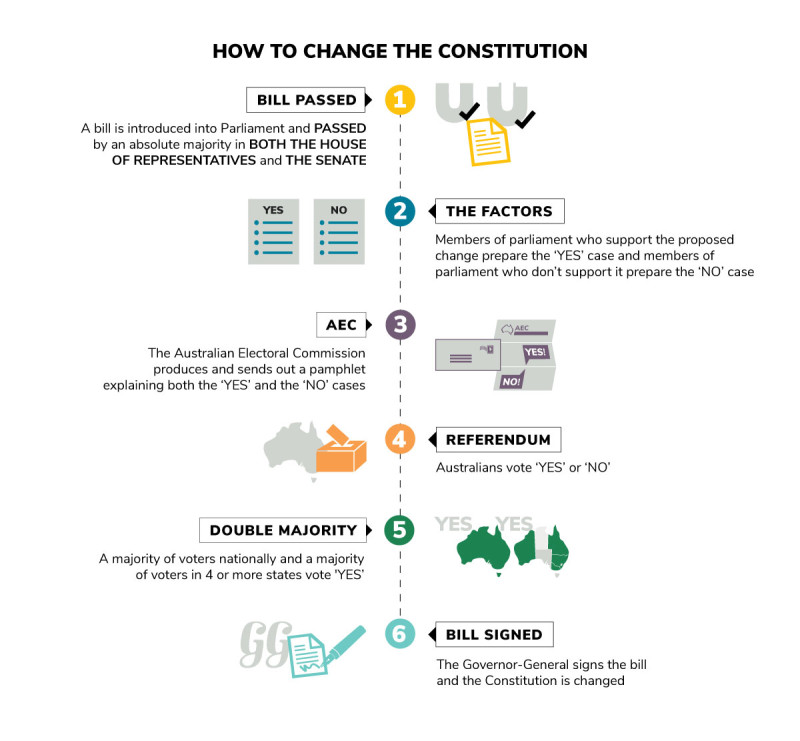
How to change the Australian Constitution
Parliamentary Education Office (PEO.GOV.AU)
How to change the Australian Constitution
Parliamentary Education Office (PEO.GOV.AU)
Description
The steps that need to be taken before the Australian Constitution can be changed:
1. Bill passed
- A bill is introduced into Parliament and PASSED by an absolute majority in both the House of Representatives and the Senate.
2. The factors
- Members of parliament who support the proposed change prepare the 'YES' case and members of parliament who don't support it prepare the 'NO' case.
3. AEC
- The Australian Electoral Commission produces and sends out a pamphlet explaining both the 'YES' and the 'NO' cases.
4. Referendum
- Australians vote 'YES' or 'NO'.
5. Double Majority
- A majority of voters nationally and a majority of voters in 4 or more states vote 'YES'
6. Bill signed
- The Governor-General signs the bill and the Constitution is changed.

This work is licensed under a Creative Commons Attribution-NonCommercial-NoDerivatives 4.0 International License.
You are free to share – copy and redistribute the material in any medium or format.
The licensor cannot revoke these freedoms as long as you follow the license terms.
Attribution – You must give appropriate credit, provide a link to the license, and indicate if changes were made. You may do so in any reasonable manner, but not in any way that suggests the licensor endorses you or your use.
Non-commercial – You may not use the material for commercial purposes.
No derivatives – If you remix, transform, or build upon the material, you may not distribute the modified material.
No additional restrictions – You may not apply legal terms or technological measures that legally restrict others from doing anything the license permits.
Waiver – any of the above conditions can be waived if you get permission from the copyright holder.