What would happen if Australia had a unitary government?
Thank you for your question, Safir.
A unitary government is a system where one central government decides the laws for the whole country. This is different to Australia’s federal system where power is shared and balanced between three levels of government – federal, state and local.
It is highly unlikely that Australia would change from a federal to a unitary government because the states would all need to agree to surrender their governing powers. In addition, the Australian Constitution would need to be altered and perhaps completely re-written. To change the Constitution in this way, a referendum – nationwide vote of electors – would be required, and every state would need to approve the change for it to be successful.
Hypothetically speaking, if Australia was to switch its system of government from federal to unitary, there would be a number of significant changes, including:
- State parliaments and governments would likely be abolished or significantly reduced in power.
- All law-making power would transfer to the national parliament in Canberra.
- The national government would take over services currently run by states (like hospitals, schools, police).
- State court systems would merge into a single national court system or become regional offices.
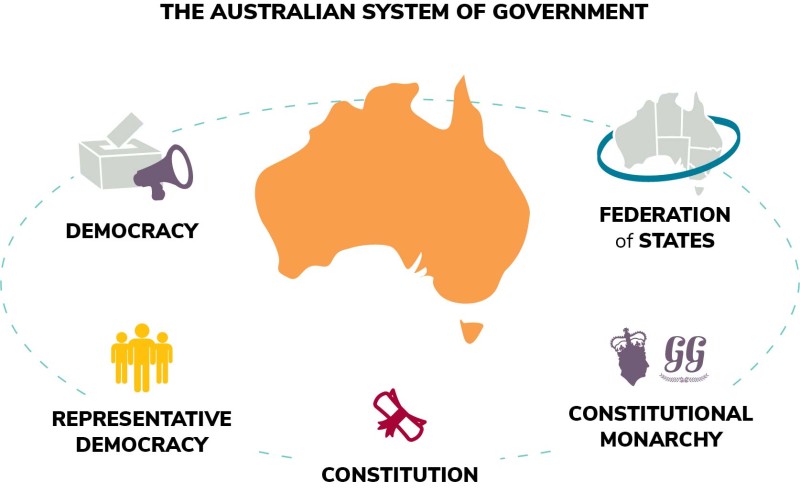
The Australian system of government
Parliamentary Education Office (PEO.GOV.AU)
The Australian system of government
Parliamentary Education Office (PEO.GOV.AU)
Description
Different components come together to make up the Australian system of government. The main features are democracy, being a representative democracy, the Australian Constitution, constitutional monarchy and being a federation of states.

This work is licensed under a Creative Commons Attribution-NonCommercial-NoDerivatives 4.0 International License.
You are free to share – copy and redistribute the material in any medium or format.
The licensor cannot revoke these freedoms as long as you follow the license terms.
Attribution – You must give appropriate credit, provide a link to the license, and indicate if changes were made. You may do so in any reasonable manner, but not in any way that suggests the licensor endorses you or your use.
Non-commercial – You may not use the material for commercial purposes.
No derivatives – If you remix, transform, or build upon the material, you may not distribute the modified material.
No additional restrictions – You may not apply legal terms or technological measures that legally restrict others from doing anything the license permits.
Waiver – any of the above conditions can be waived if you get permission from the copyright holder.