What is the difference between exclusive, residual and concurrent law-making powers?
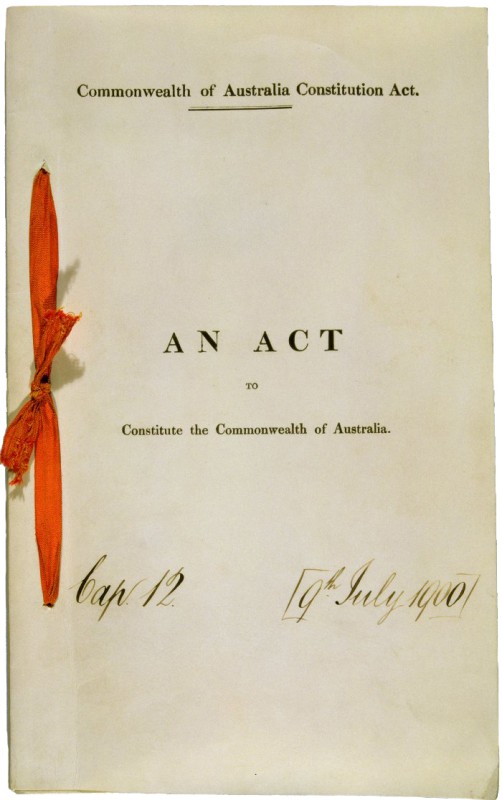
Commonwealth of Australia Constitution Act, 1900: Original Public Record Copy (1900).
Parliament House Art Collection, Art Services Parliament House
Commonwealth of Australia Constitution Act, 1900: Original Public Record Copy (1900).
Parliament House Art Collection, Art Services Parliament House
Description
This image shows the front page of the original public record copy of the Commonwealth of Australia Constitution Act 1900.
Permission for publication must be sought from Parliament House Art Collection. Contact DPS Art Services, phone: 02 62775034 or 02 62775123
Thanks for the complex question Trudy!
In the Australian Constitution, power is divided between the federal and state levels of government. The Constitution sets out which powers belong to the Australian Parliament, which remain with the states and which belong to both. These are 'exclusive', 'residual' or 'concurrent' powers.
Exclusive powers can only be used by the Australian Parliament, not the states. The powers listed in sections 52, 86, 90 and 122 are all exclusive to the Australian Parliament. For example, section 52 of the Constitution says that the Australian Parliament has exclusive responsibility to make laws about the federal public service.
Residual powers are those that were not granted to the Australian Parliament when the Constitution was written. Unless the Constitution says otherwise, state parliaments can use the law-making powers they had as colonial parliaments before Federation (section 107).
Concurrent powers can be used by both the Australian Parliament and state parliaments. For example, state parliaments and the Australian Parliament can make laws relating to the environment, marriage, and tax. However, if a state parliament makes a law which is inconsistent with a federal law, section 109 of the Constitution states that the federal law overrides the state law.