What is a Dorothy Dixer question?
Thank you for your question, Cliff.
A ‘Dorothy Dixer’ is a question asked of a government minister by a government backbencher during Question Time. Unlike questions asked by the opposition, which are intended to closely examine the work of the government, Dorothy Dixers are designed to highlight government policies and achievements.
The name comes from a popular advice columnist called Dorothy Dix. It was rumoured that Dorothy Dix sometimes wrote the questions that she answered in her newspaper columns.
In the Australian Parliament, ministers know in advance that a Dorothy Dixer is going to be asked. This gives them time to prepare a response. Like the real Dorothy Dix, they may have even written the question themselves.
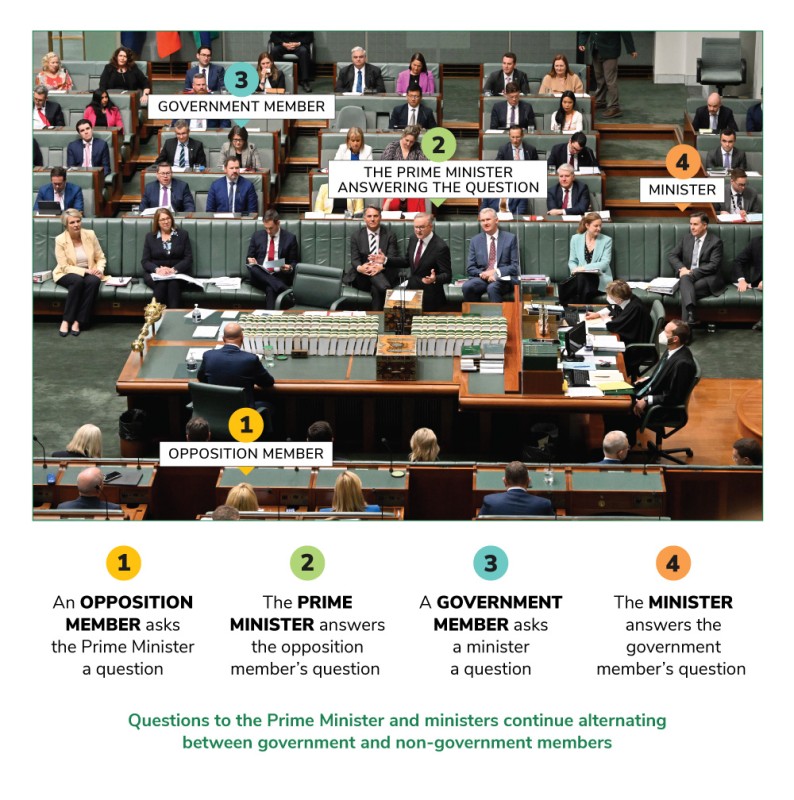
Question Time in the House of Representatives
Parliamentary Education Office (peo.gov.au), DPS AUSPIC
Question Time in the House of Representatives
Parliamentary Education Office (peo.gov.au), DPS AUSPIC
Description
This image shows the main people involved in Question Time in the House of Representatives:
- An opposition member asks the Prime Minister a question
- The Prime Minister answers the opposition member's question
- A Government member asks a minister a question
- The minister answer the government member's question.
Questions to the Prime Minister and ministers continue alternating between government and non-government members.

This work is licensed under a Creative Commons Attribution-NonCommercial-NoDerivatives 4.0 International License.
You are free to share – copy and redistribute the material in any medium or format.
The licensor cannot revoke these freedoms as long as you follow the license terms.
Attribution – You must give appropriate credit, provide a link to the license, and indicate if changes were made. You may do so in any reasonable manner, but not in any way that suggests the licensor endorses you or your use.
Non-commercial – You may not use the material for commercial purposes.
No derivatives – If you remix, transform, or build upon the material, you may not distribute the modified material.
No additional restrictions – You may not apply legal terms or technological measures that legally restrict others from doing anything the license permits.
Waiver – any of the above conditions can be waived if you get permission from the copyright holder.