What is a concurrent power and what is an example of one?
Some of the federal Parliament's law-making powers listed in the Australian Constitution are exclusive – this means only the federal Parliament can make laws about these topics. A concurrent power is a law-making power shared by the federal Parliament and the state parliaments. This means both can make laws about the same matter. However, if a state parliament makes a law which conflicts with a federal law, section 109 of the Constitution says that the federal law overrides the state law.
Industrial relations, which includes rules for working conditions, is an example of a concurrent power. At Federation, the states kept the power to resolve workplace disagreements and make labour laws. Meanwhile, the Constitution gave the federal Parliament the power to:
- resolve and prevent disagreements between workers and employers that involve more than one state (section 51(xxxv))
- make laws for some corporations, including foreign companies operating in Australia (section 51(xx))
- sign international treaties to protect the rights of workers (section 51 (xxix)).
These powers allowed the federal Parliament to create national industrial relations tribunals and make national workplace laws (such as the Sex Discrimination Act 1984).
Before 2009, the federal government and the states operated separate but overlapping industrial relations systems. The Constitution allows states to refer matters to the federal Parliament and, in 2009, all the states (except Western Australia) handed over their industrial relations powers. Federal Parliament then passed the Fair Work Act 2009 creating the current national industrial relations system which covers the majority of Australian workers.
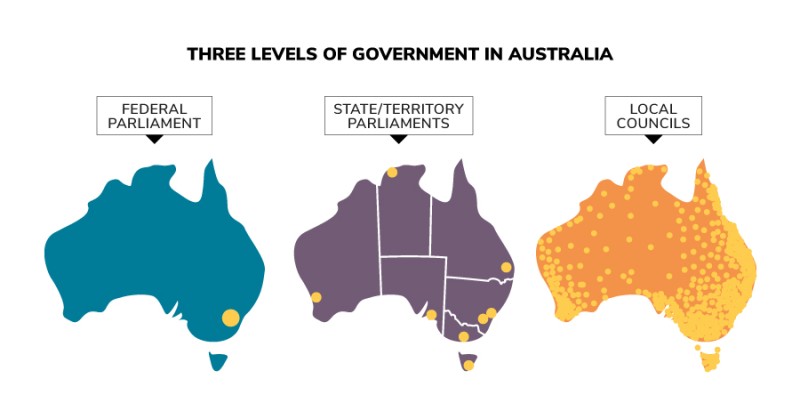
Three levels of government in Australia
Parliamentary Education Office (peo.gov.au)
Three levels of government in Australia
Parliamentary Education Office (peo.gov.au)
Description
The three levels of government – the law-making bodies in Australia. The Federal Parliament is located in Canberra, the nation's capital. State/territory parliaments are located in the capital cities of each of the 6 states and 2 territories. Local councils are located around Australia in each local council division.

This work is licensed under a Creative Commons Attribution-NonCommercial-NoDerivatives 4.0 International License.
You are free to share – copy and redistribute the material in any medium or format.
The licensor cannot revoke these freedoms as long as you follow the license terms.
Attribution – You must give appropriate credit, provide a link to the license, and indicate if changes were made. You may do so in any reasonable manner, but not in any way that suggests the licensor endorses you or your use.
Non-commercial – You may not use the material for commercial purposes.
No derivatives – If you remix, transform, or build upon the material, you may not distribute the modified material.
No additional restrictions – You may not apply legal terms or technological measures that legally restrict others from doing anything the license permits.
Waiver – any of the above conditions can be waived if you get permission from the copyright holder.