What if none of a voter's preferences gets a quota in a Senate election?
Thanks for asking, Geoff. To best answer your question, we’ll begin with a quick refresher on Senate elections.
To be elected, candidates need to gain a quota – a set proportion of the formal votes. When a candidate receives more than the required quota, these ‘extra’ votes are distributed to the next preference on each ballot paper. The votes are then recounted. This process repeats until all vacancies in the Senate are filled.
However, if all vacancies are not filled using this method, the candidate with the fewest votes is excluded from the count. If a voter’s first choice is excluded, their vote goes to their next preferred candidate. This process continues until all vacancies are filled, with votes moving to each voters’ next available preference when their preferred candidate is excluded.
For some voters, this may result in their vote being considered 'exhausted'. This is when all of their preferred candidates have been excluded and there are no preferences remaining on their ballot paper. When an 'exhausted vote' occurs the ballot paper is set aside and not counted towards any candidate.
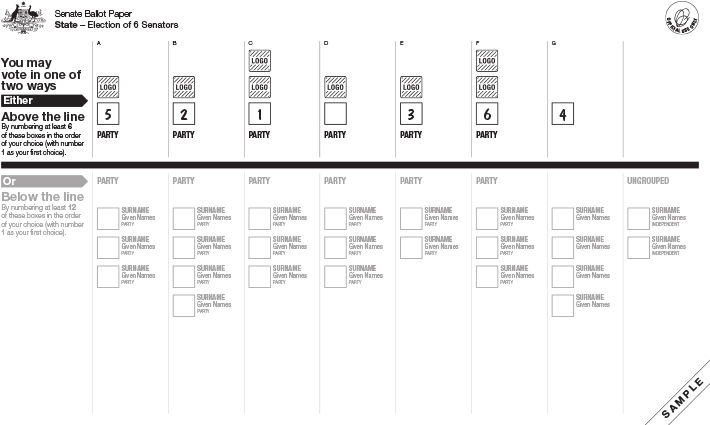
Sample Senate ballot paper – voting above the line
Australian Electoral Commission
Sample Senate ballot paper – voting above the line
Australian Electoral Commission
Description
This image is of a sample Senate ballot paper showing how to cast a valid vote above the line. There is a printed black horizontal line through the ballot paper. There are 7 boxes with 'Party' written above the line. These boxes have been numbered 1 to 6, one box has been left blank. There are many boxes with 'Surname, Given names, party' written below the line. All the boxes below the line have been left blank.
Permission should be sought from the Australian Electoral Commission (AEC) for third-party or commercial uses of this image. To contact the AEC email: media@aec.gov.au or phone: 13 23 26.