Is there an established list of portfolios for the government? How do they get allocated?
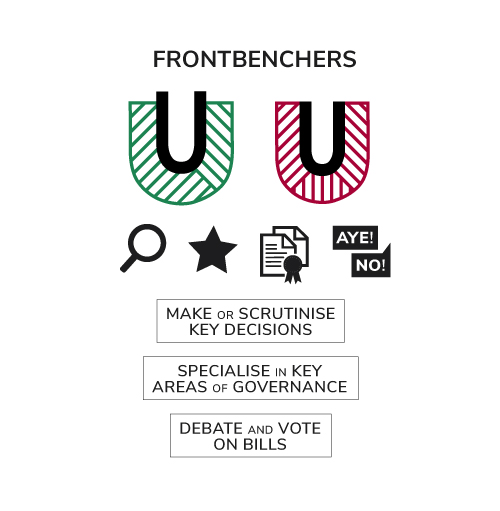
Role of frontbenchers in the Australian Parliament
Parliamentary Education Office (peo.gov.au)
Role of frontbenchers in the Australian Parliament
Parliamentary Education Office (peo.gov.au)
Description
Ministers and shadow ministers are also known as 'frontbenchers' because they sit on the front bench of the Senate or House of Representatives. Ministers and shadow ministers make and scrutinise key decisions, specialise in key areas of governance, and debate and vote on bills.

This work is licensed under a Creative Commons Attribution-NonCommercial-NoDerivatives 4.0 International License.
You are free to share – copy and redistribute the material in any medium or format.
The licensor cannot revoke these freedoms as long as you follow the license terms.
Attribution – You must give appropriate credit, provide a link to the license, and indicate if changes were made. You may do so in any reasonable manner, but not in any way that suggests the licensor endorses you or your use.
Non-commercial – You may not use the material for commercial purposes.
No derivatives – If you remix, transform, or build upon the material, you may not distribute the modified material.
No additional restrictions – You may not apply legal terms or technological measures that legally restrict others from doing anything the license permits.
Waiver – any of the above conditions can be waived if you get permission from the copyright holder.
Interesting question Elisa. There is no set list of portfolios. The prime minister decides which members of the government will be ministers and which portfolio they will have.
To clarify, a portfolio is an area of responsibility within the Australian Government. A minister is a member of the Government who is assigned one of these portfolios to help run the country.
Some portfolios, such as Treasurer and Minister for Defence, usually stay the same. Other portfolios are added, removed, combined or split by each new government. This often depends on the areas the government wants to focus on. For example, at different times there has been a Minister for Regional Health, Regional Communications and Local Government, a Minister for Health and a Minister for Communications. There can be no more than 30 ministers at one time.
You can find a current list of ministers in the Australian Government here.