Is there a list showing which parts of the Constitution authorise each law passed by the Parliament?
Thanks for your question, Phillip. In short, the answer is no!
However, there are a number of processes that help ensure laws passed by the Australian Parliament are consistent with the Australian Constitution.
For a bill to become a law, it needs to be passed by both the Senate and the House of Representatives. This means the majority of members of parliament agree to the bill by voting in support of it. Before senators and members vote, they have the opportunity to scrutinise – closely examine – the bill, including raising any concerns about whether the proposed law is unconstitutional.
If both houses agree to a bill, it is presented to the Governor-General for Royal Assent. The Governor-General shares in the responsibility for ensuring that Australia is governed according to the rules set out in the Australian Constitution. They can question whether a proposed law is constitutional and withhold Royal Assent for a bill considered unconstitutional.
Even following Royal Assent, an Act of Parliament may be challenged in the High Court of Australia which can strike down a law if it is found to be unconstitutional.
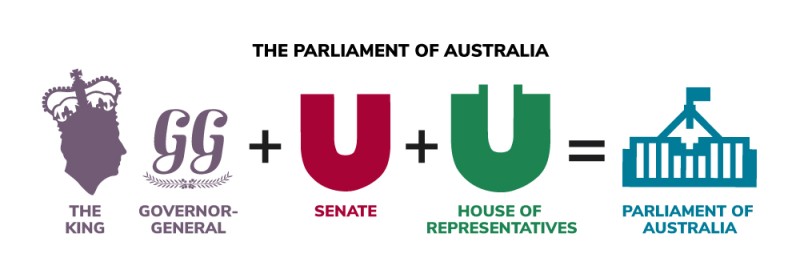
Parliament of Australia
Parliamentary Education Office (peo.gov.au)
Parliament of Australia
Parliamentary Education Office (peo.gov.au)
Description
This diagram illustrates the composition of the Australian Parliament. The Australian Parliament is made up of the King (represented by the Governor-General), the Senate and the House of Representatives.

This work is licensed under a Creative Commons Attribution-NonCommercial-NoDerivatives 4.0 International License.
You are free to share – copy and redistribute the material in any medium or format.
The licensor cannot revoke these freedoms as long as you follow the license terms.
Attribution – You must give appropriate credit, provide a link to the license, and indicate if changes were made. You may do so in any reasonable manner, but not in any way that suggests the licensor endorses you or your use.
Non-commercial – You may not use the material for commercial purposes.
No derivatives – If you remix, transform, or build upon the material, you may not distribute the modified material.
No additional restrictions – You may not apply legal terms or technological measures that legally restrict others from doing anything the license permits.
Waiver – any of the above conditions can be waived if you get permission from the copyright holder.