How many staff work in a senator or member’s office and what do they do?
All senators and members of the House of Representatives can employ staff to help them with their parliamentary and electorate duties, but the exact number of staff and their duties vary.
Under the Members of Parliament (Staff) Act 1984 (MOP(S) Act), members of parliament can employ 4 full‑time electorate officers. These officers work in electorate offices assisting people in the community. One officer from each office can also work in Parliament House. Members with large electorates are allowed to employ extra staff.
Some members of parliament also have personal staff to help manage their workload and support their parliamentary duties. The Prime Minister decides who gets personal staff. Personal staff are usually provided to members of parliament with extra responsibilities, such as:
- ministers and assistant ministers
- the Presiding Officers
- the Leader of the Opposition and shadow ministers
- government, opposition and minor party whips.
Members of parliament with a special role (for example, a special envoy) may be given an extra staff member. Independent and minor party members have a personal staff member each.
Some members of parliament employ a Chief of Staff. This is a senior staff position in their office. Members who have the heaviest workloads and the most staff to manage usually employ a Chief of Staff, like the Prime Minister, Leader of the Opposition and ministers. A Chief of Staff generally manages the office and supports the member, but their exact duties are decided by the member.
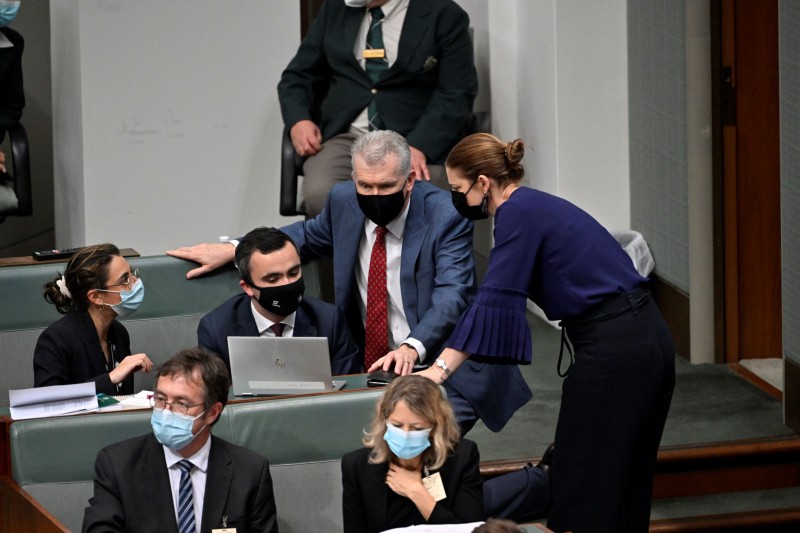
Member of the House of Representatives talking to their advisers
DPS Auspic
Member of the House of Representatives talking to their advisers
DPS Auspic
Description
Two members of the House of Representatives standing next to the advisers' box to talk to their staff members, called advisers, during Question Time in the House. The advisers are sitting in benches in the box. Members of parliament must move to the advisers’ box if they need to speak with their staff, as advisers are not permitted to move around the room. The members are looking at a laptop as they speak to the advisers. Advisers can bring papers, books or laptops into the advisers' box to help quickly provide information to members of parliament.
Permission should be sought from DPS AUSPIC for third-party or commercial uses of this image. To contact DPS AUSPIC email: auspic@aph.gov.au or phone: 02 6277 3342.