Does section 34 (Qualifications of members) conflict with section 44 (Disqualifications), particularly in relation to UK and New Zealand citizens?
Thanks for your question about the Australian Constitution.
Section 44 may seem to conflict with section 34 about the eligibility of citizens of the United Kingdom and New Zealand to sit in the Australian Parliament. Interpretation by the High Court of Australia and the Commonwealth Electoral Act 1918 has now removed any potential conflict.
Section 44 of the Constitution sets out the reasons a person may be disqualified from sitting in Parliament. A citizen of a foreign power has now been interpreted to mean that someone who holds dual citizenship (for example, with the UK or New Zealand) is disqualified.
Section 34 states that members of the House of Representatives must have lived in Australia for at least 3 years and must be a ‘subject of the Queen,’ which included people from the UK and New Zealand at the time the Constitution was written. However, section 34 begins with the phrase ‘Until the Parliament otherwise provides ….’ which allows the Australian Parliament to change this section by making a law.
The Parliament created the Commonwealth Electoral Act 1918 which set the rules for who is allowed to sit in Parliament. It stated in order to become a member of the House of Representatives a person must:
- have reached the age of 21 years (later changed to 18)
- be an Australian citizen
- be an elector, or qualified to be an elector, who is entitled to vote in a House of Representatives election.
This Act effectively replaced the section 34 requirements for qualifications of members.
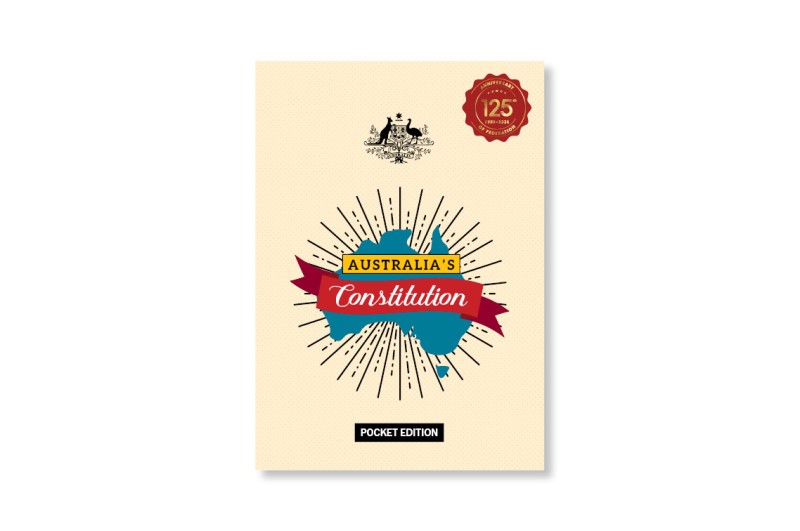
Australia's Constitution front cover
Parliamentary Education Office
Australia's Constitution front cover
Parliamentary Education Office
Description
Front cover of the pocket edition of Australia's Constitution.

This work is licensed under a Creative Commons Attribution-NonCommercial-NoDerivatives 4.0 International License.
You are free to share – copy and redistribute the material in any medium or format.
The licensor cannot revoke these freedoms as long as you follow the license terms.
Attribution – You must give appropriate credit, provide a link to the license, and indicate if changes were made. You may do so in any reasonable manner, but not in any way that suggests the licensor endorses you or your use.
Non-commercial – You may not use the material for commercial purposes.
No derivatives – If you remix, transform, or build upon the material, you may not distribute the modified material.
No additional restrictions – You may not apply legal terms or technological measures that legally restrict others from doing anything the license permits.
Waiver – any of the above conditions can be waived if you get permission from the copyright holder.