Why can there be a federal minister for something that is a state responsibility?
Thanks for your question.
Although federal and state governments provide different services, some of their responsibilities can overlap. Some areas are mainly managed by the states, but the federal government can also act in these areas and influence how they operate. This is why ministers are appointed in both the federal and state or territory governments to oversee similar areas.
For example, education is mainly managed by states and territories, but the federal government also has responsibility for some parts of education. The federal Minister for Education is responsible for areas such as childcare and university funding, international education and research. State and territory education ministers are responsible for teacher training, school resourcing and the curriculum within their state or territory.
Likewise, the different levels of government have different responsibilities for health. The federal minister oversees national policies, health funding and national disease prevention programs. The minister is also responsible for Medicare and the Pharmaceutical Benefits Scheme (PBS), which help people pay for doctor visits and medicines. State and territory health ministers manage the day-to-day delivery of public health services, including hospitals, emergency services and community health clinics.
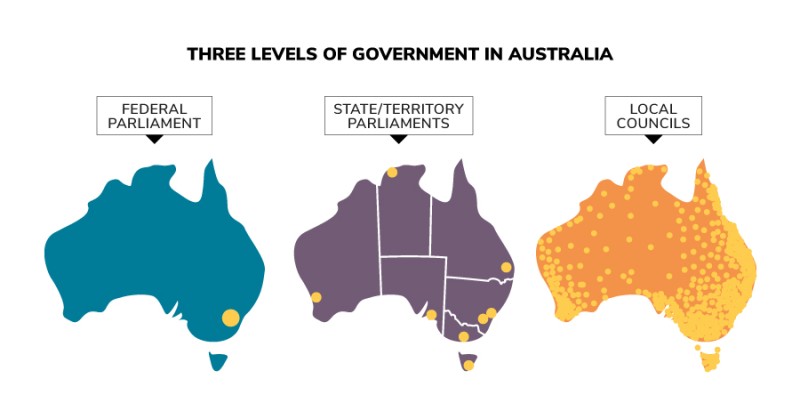
Three levels of government in Australia
Parliamentary Education Office (peo.gov.au)
Three levels of government in Australia
Parliamentary Education Office (peo.gov.au)
Description
The three levels of government – the law-making bodies in Australia. The Federal Parliament is located in Canberra, the nation's capital. State/territory parliaments are located in the capital cities of each of the 6 states and 2 territories. Local councils are located around Australia in each local council division.

This work is licensed under a Creative Commons Attribution-NonCommercial-NoDerivatives 4.0 International License.
You are free to share – copy and redistribute the material in any medium or format.
The licensor cannot revoke these freedoms as long as you follow the license terms.
Attribution – You must give appropriate credit, provide a link to the license, and indicate if changes were made. You may do so in any reasonable manner, but not in any way that suggests the licensor endorses you or your use.
Non-commercial – You may not use the material for commercial purposes.
No derivatives – If you remix, transform, or build upon the material, you may not distribute the modified material.
No additional restrictions – You may not apply legal terms or technological measures that legally restrict others from doing anything the license permits.
Waiver – any of the above conditions can be waived if you get permission from the copyright holder.