What were the arguments for and against federation?
Thank you for your question. There were many reasons why Australia federated in 1901 but not everyone agreed that this was a good idea.
Australia became a nation on 1 January 1901 when the 6 British colonies – New South Wales, Victoria, Queensland, Western Australia, and Tasmania – joined the Commonwealth of Australia, a process known as Federation.
Before this, the colonies were almost like separate countries. For example, each had their own government and law, defence force, issued its own stamps, and collected taxes on goods that crossed its borders. The colonies even built railways using different track widths. This caused problems and people began to discuss the benefits of a national government.
Arguments for Federation
- Stronger defence – a united army and navy would provide better protection for all.
- Easier trade – by removing borders and individual taxes, trade would increase and strengthen the economy.
- Fairer laws – a national government would make laws that applied to everyone, for example crime and immigration.
- Improved services – mail, railways and communication could be managed more effectively by one government instead of 6.
- National pride – many people felt proud to be Australian and wanted to be united under one flag and government.
Arguments against Federation
- High cost and effort – creating a new national parliament would be expensive and complicated.
- Loss of local power – some colonies worried that they would have to compromise on issues such as finance and immigration.
- Unequal influence – smaller colonies feared that larger ones, like New South Wales and Victoria would dominate decision making.
- Fear of change – some people were simply unsure about how Federation would work and didn't want to take the risk.
The public played a role in the Federation debate by voting in a series of referendums held in each colony to approve the proposed constitution. However, not everyone was part of the process. Aboriginal and Torres Strait Islander peoples were largely excluded, and women could only vote in South Australia and Western Australia.
Ultimately, the 6 colonies agreed to Federation because more people believed that the benefits of one national government outweighed the reasons against unification.
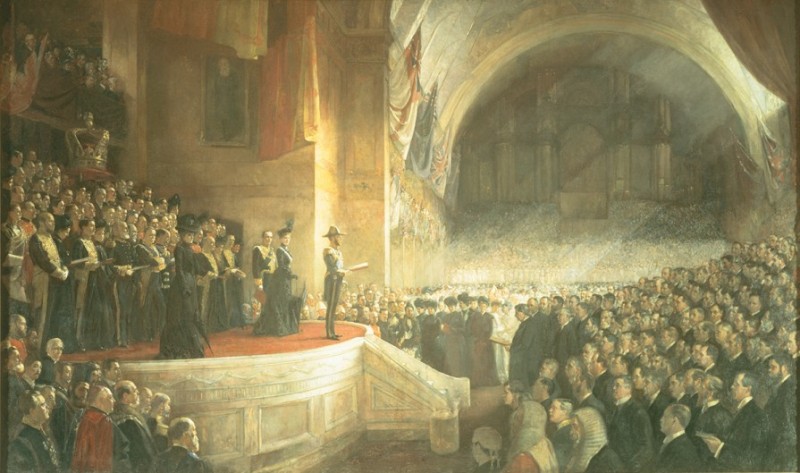
Opening of the First Parliament of the Commonwealth of Australia by H.R.H. The Duke of Cornwall and York (Later King George V), May 9, 1901
Parliament House Art Collection, Canberra, ACT and the Royal Collection Trust.
Opening of the First Parliament of the Commonwealth of Australia by H.R.H. The Duke of Cornwall and York (Later King George V), May 9, 1901
Parliament House Art Collection, Canberra, ACT and the Royal Collection Trust.
Description
This painting was painted by Australian artist Tom Roberts. It is known as the 'Big Picture', although its official name is 'Opening of the First Parliament of the Commonwealth of Australia by H.R.H. The Duke of Cornwall and York (Later King George V), May 9, 1901.'
The ‘Big Picture’ includes 269 portraits of the people who attended the opening of the First Parliament, including the Governor-General, the members of the Senate and House of Representatives, and Australia’s first Prime Minister, Edmund Barton.
Permission for publication must be sought from Parliament House Art Collection. Contact DPS Art Services, phone: 02 62775034 or 02 62775123