What is the role of Attorney-General in law making in the Australian Parliament?
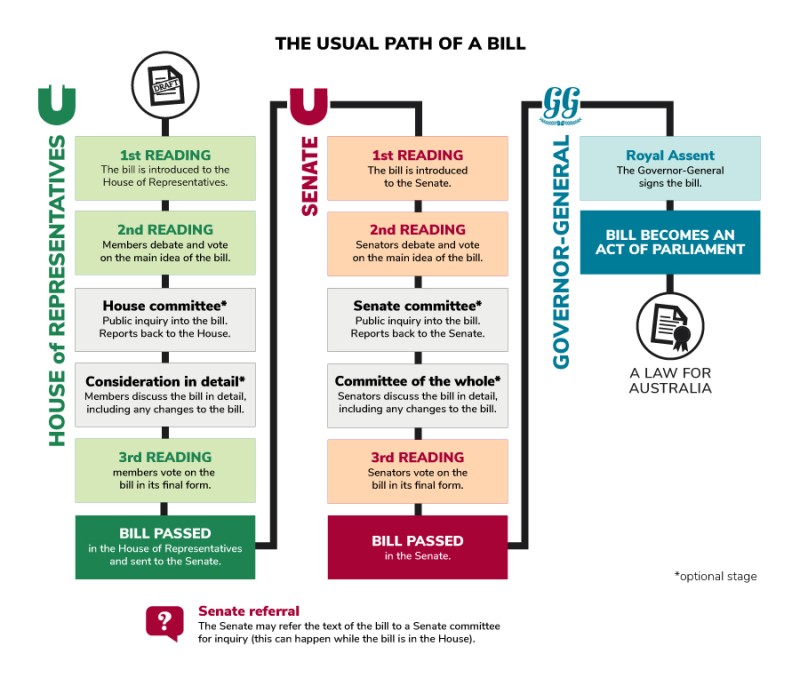
The usual path of a bill
Parliamentary Education Office (peo.gov.au)
The usual path of a bill
Parliamentary Education Office (peo.gov.au)
Description
The usual path of a bill through the Australian Parliament to become Australian law.
In the House of Representatives a bill goes through the following stages:
- 1st reading – the bill is introduced to the House of Representatives
- 2nd reading – members debate and vote on the main idea of the bill
- House committee (optional stage) – public inquiry into the bill and reporting back to the House
- Consideration in detail (optional stage) – members discuss the bill in detail, including any changes to the bill
- 3rd reading – members vote on the bill in its final form
- the bill is passed in the House of Representatives and sent to the Senate.
Senate referral – the Senate may refer the text of the bill to a Senate committee for inquiry (this can happen while the bill is in the House).
In the Senate a bill goes through the following stages:
- 1st reading – the bill is introduced to the Senate
- 2nd reading – senators debate and vote on the main idea of the bill
- Senate committee (optional stage) – public inquiry into the bill and reporting back to the Senate
- Committee of the whole (optional stage) – senators discuss the bill in detail, including any changes to the bill
- 3rd reading – senators vote on the bill in its final form
- the bill is passed in the Senate.
The bill is given Royal Assent – The Governor-General signs the bill.
The bill becomes an Act of Parliament – a law for Australia.

This work is licensed under a Creative Commons Attribution-NonCommercial-NoDerivatives 4.0 International License.
You are free to share – copy and redistribute the material in any medium or format.
The licensor cannot revoke these freedoms as long as you follow the license terms.
Attribution – You must give appropriate credit, provide a link to the license, and indicate if changes were made. You may do so in any reasonable manner, but not in any way that suggests the licensor endorses you or your use.
Non-commercial – You may not use the material for commercial purposes.
No derivatives – If you remix, transform, or build upon the material, you may not distribute the modified material.
No additional restrictions – You may not apply legal terms or technological measures that legally restrict others from doing anything the license permits.
Waiver – any of the above conditions can be waived if you get permission from the copyright holder.
When it comes to law-making, the Attorney-General introduces bills – proposed laws – relating to their portfolio – their area of responsibility.
The Attorney-General is the top law officer in the nation, and their portfolio includes legal matters, the Australian justice system and national security. They can give legal advice to the government and the Cabinet – the prime minister and top-level ministers.
When they introduce a bill, they explain why they think it is a good law for Australia. The Attorney-General votes on bills like all other members of parliament.