What is the difference between policy, act, and legislation in Australia?
Hi Raj, thanks for your question.
A policy is a plan of action to address an issue. Political parties develop policies about issues which they think are important in Australia.
A law passed by the Australian Parliament is called an Act of Parliament. Laws start as bills – proposed laws – that plan to put policies into action. Bills are considered by the Parliament, and if passed, are signed into law by the Governor-General. Legislation is a general term for the laws or Acts made by Parliament.
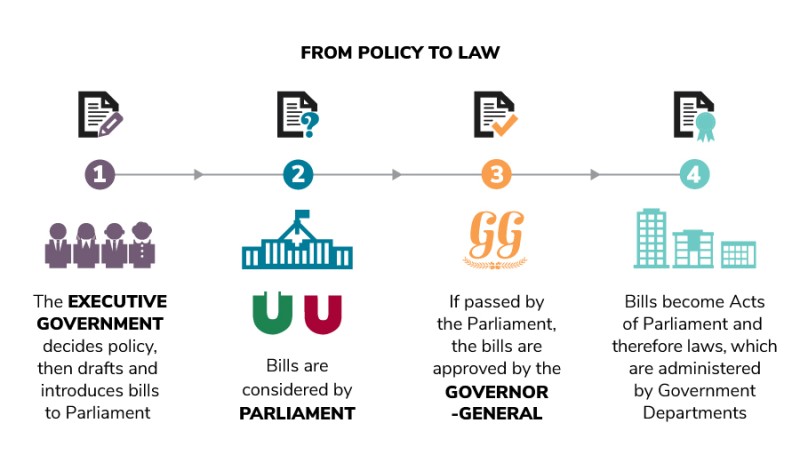
From policy to law
Parliamentary Education Office (peo.gov.au)
From policy to law
Parliamentary Education Office (peo.gov.au)
Description
The role of executive government in turning policy into law:
1. The executive government decides policy then drafts and introduces bills to the Parliament.
2. Bills are considered by Parliament (in the House of Representatives and the Senate).
3. If passed by Parliament, the bills are approved by the Governor-General.
4. Bills become Acts of Parliament and therefore laws, which are administered by government departments.

This work is licensed under a Creative Commons Attribution-NonCommercial-NoDerivatives 4.0 International License.
You are free to share – copy and redistribute the material in any medium or format.
The licensor cannot revoke these freedoms as long as you follow the license terms.
Attribution – You must give appropriate credit, provide a link to the license, and indicate if changes were made. You may do so in any reasonable manner, but not in any way that suggests the licensor endorses you or your use.
Non-commercial – You may not use the material for commercial purposes.
No derivatives – If you remix, transform, or build upon the material, you may not distribute the modified material.
No additional restrictions – You may not apply legal terms or technological measures that legally restrict others from doing anything the license permits.
Waiver – any of the above conditions can be waived if you get permission from the copyright holder.