What is judicial review of a government action?
Judicial review is when a court is asked to check if a decision made by the Australian Government, or a government department, was made properly and followed the law. It plays an important role in Australia’s system of government by ensuring the accountability of the Government.
Judicial review might relate to decisions on things like visas, citizenship applications, welfare payments and environmental projects. If someone believes the correct process wasn’t followed when making the decision, they can apply to a court for judicial review, such as the Federal Court of Australia.
The court will then decide if the Government decision was legal and if the Government had the power to make the decision. The court will also check that the decision was made fairly and without bias, and that all relevant information was considered.
If the court finds that a Government decision was unlawful, the decision will be overturned, and the Government can be forced to re-make a decision according to the law.
In many cases, people can first ask a tribunal, like the Administrative Review Tribunal, to look at the decision. This is called merits review. The tribunal can make a new decision taking into account the facts, law and policy. Judicial review is different, as it looks at whether the law was followed.
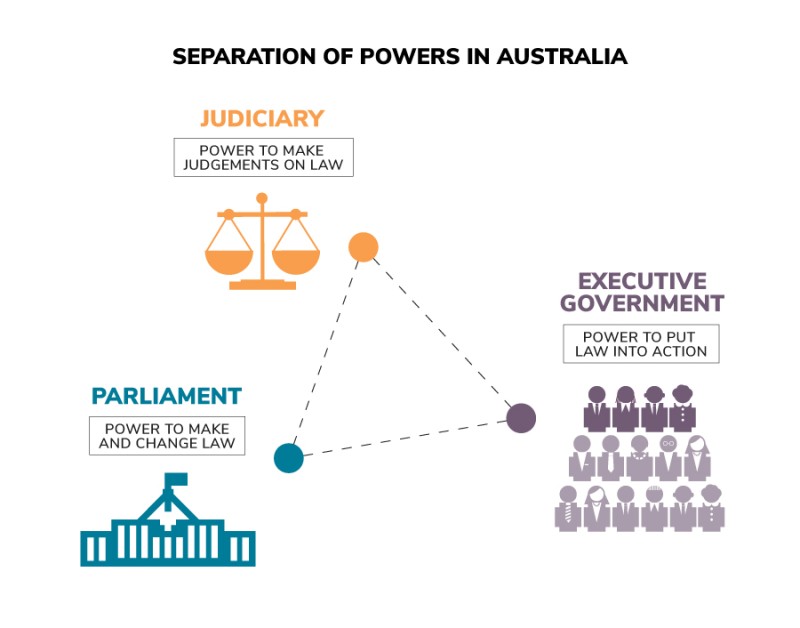
Separation of powers in Australia
Parliamentary Education Office (peo.gov.au)
Separation of powers in Australia
Parliamentary Education Office (peo.gov.au)
Description
This diagram illustrates the separation of powers in the Australian system of government. The Parliament (represented by an icon of Australian Parliament House) has the power to make and change law. The Executive (represented by a group of people) has the power to put law into action. The Judiciary (represented by an icon of a scale) has the power to make judgements on law. The three groups – Parliament, Executive and Judiciary – are connected.

This work is licensed under a Creative Commons Attribution-NonCommercial-NoDerivatives 4.0 International License.
You are free to share – copy and redistribute the material in any medium or format.
The licensor cannot revoke these freedoms as long as you follow the license terms.
Attribution – You must give appropriate credit, provide a link to the license, and indicate if changes were made. You may do so in any reasonable manner, but not in any way that suggests the licensor endorses you or your use.
Non-commercial – You may not use the material for commercial purposes.
No derivatives – If you remix, transform, or build upon the material, you may not distribute the modified material.
No additional restrictions – You may not apply legal terms or technological measures that legally restrict others from doing anything the license permits.
Waiver – any of the above conditions can be waived if you get permission from the copyright holder.