What happens to a law that is not passed by one of the houses?
Great question George! If one of the houses doesn't pass a bill – a proposal for a new law – then it cannot become a law. Both the Senate and the House of Representatives have to agree to a bill for it to become a law.
If one of the houses doesn't pass a bill, then the originating house – the house in which the bill was first introduced – may:
- pass the bill again and send it back to the second house
- change the bill so the second house will be more likely to pass it
- lay the bill aside (not go forward with the bill).
Section 57 of the Australian Constitution allows a way forward if the Senate and House of Representatives cannot agree on a bill introduced in the House of Representatives. If the Senate and the House cannot agree on a bill introduced twice in the House of Representatives (and all the requirements in the Constitution have been met), the Prime Minister can ask the Governor-General to call an election for all the seats in the House of Representatives and the Senate. This is called a double dissolution. It is designed to break the deadlock between the houses. It has occurred 7 times.
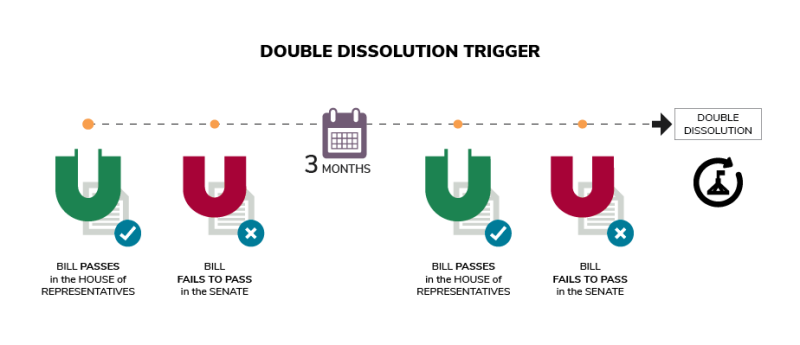
Double dissolution trigger
Parliamentary Education Office (peo.gov.au)
Double dissolution trigger
Parliamentary Education Office (peo.gov.au)
Description
The process for a double dissolution:
- bill passes in the House of Representatives
- bill fails to pass in the Senate
- three months pass
- bill passes in the House of Representatives
- bill fails to pass in the Senate
- double dissolution can be requested.

This work is licensed under a Creative Commons Attribution-NonCommercial-NoDerivatives 4.0 International License.
You are free to share – copy and redistribute the material in any medium or format.
The licensor cannot revoke these freedoms as long as you follow the license terms.
Attribution – You must give appropriate credit, provide a link to the license, and indicate if changes were made. You may do so in any reasonable manner, but not in any way that suggests the licensor endorses you or your use.
Non-commercial – You may not use the material for commercial purposes.
No derivatives – If you remix, transform, or build upon the material, you may not distribute the modified material.
No additional restrictions – You may not apply legal terms or technological measures that legally restrict others from doing anything the license permits.
Waiver – any of the above conditions can be waived if you get permission from the copyright holder.