What are some rules in the Constitution that protect rights?
Thank you for your question about the Australian Constitution and how it protects rights.
Unlike some countries, such as the United States of America, the Australian Constitution does not include a Bill of Rights which specifically lists the rights of its citizens.
However, the Constitution does mention and protect some rights:
- Section 51 (xxxi) requires that the Australian Government may only acquire property on ‘just terms.’
- Section 80 guarantees the right to trial ‘by jury’ for federal cases.
- Section 92 requires that trade and commerce between the states shall be ‘absolutely free.’
- Section 116 guarantees a range of religious freedoms, including the right to engage in the ‘free exercise of any religion.’
- Section 117 protects people against ‘any disability or discrimination’ based on which state they live in.
Many other rights are protected in Australia even if they are not mentioned in the Constitution. This occurs because:
- the Australian Parliament (along with state and territory parliaments) has made laws to protect specific rights
- there is a long history of courts making judgements to protect specific rights through what is known as common or case law.
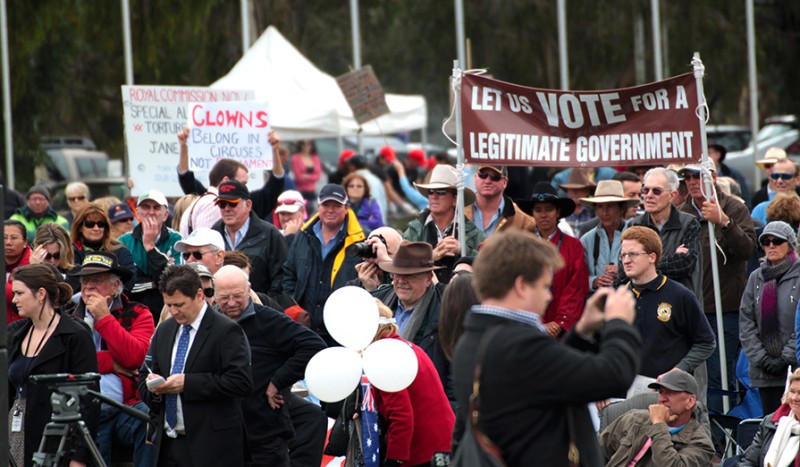
A protest at Australian Parliament House
Parliamentary Education Office (peo.gov.au)
A protest at Australian Parliament House
Parliamentary Education Office (peo.gov.au)
Description
A large group of people are protesting outside Australian Parliament House. Some are holding signs, including one that says 'let us vote for a legitimate government'. There is a camera tripod in the foreground and some people are also using cameras.

This work is licensed under a Creative Commons Attribution-NonCommercial-NoDerivatives 4.0 International License.
You are free to share – copy and redistribute the material in any medium or format.
The licensor cannot revoke these freedoms as long as you follow the license terms.
Attribution – You must give appropriate credit, provide a link to the license, and indicate if changes were made. You may do so in any reasonable manner, but not in any way that suggests the licensor endorses you or your use.
Non-commercial – You may not use the material for commercial purposes.
No derivatives – If you remix, transform, or build upon the material, you may not distribute the modified material.
No additional restrictions – You may not apply legal terms or technological measures that legally restrict others from doing anything the license permits.
Waiver – any of the above conditions can be waived if you get permission from the copyright holder.