The states can refer powers to the federal Parliament but does the federal Parliament have to accept?
Thanks for your question. The Australian Constitution says states can refer – give – the federal Parliament some of their law-making powers (section 51(xxxvii)). This transfer of power requires both the state and the federal parliaments to pass bills – proposed laws. Before any bills surrendering or accepting powers are introduced, both the state and federal parliaments usually agree to the transfer. However, in theory the federal Parliament could refuse to pass a bill accepting the referral.
An example of a referral is when each of the states passed laws allowing the federal Parliament to pass the Criminal Code Amendment (Terrorism) Act (2003). The referring Acts included the condition that the Act could not be amended – changed – without the agreement of the states.
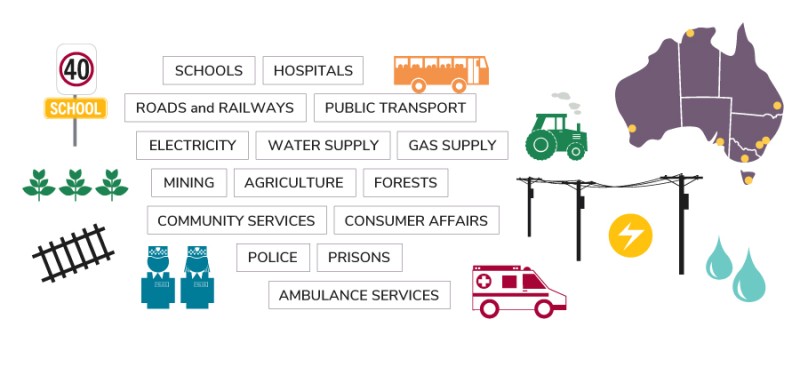
The law-making powers of state parliaments
Parliamentary Education Office (peo.gov.au)
The law-making powers of state parliaments
Parliamentary Education Office (peo.gov.au)
Description
The law-making powers of the state parliaments include:
- schools
- hospitals
- roads and railways
- public transport
- electricity
- water supply
- gas supply
- mining
- agriculture
- forests
- community services
- consumer affairs
- police
- prisons
- ambulance services.

This work is licensed under a Creative Commons Attribution-NonCommercial-NoDerivatives 4.0 International License.
You are free to share – copy and redistribute the material in any medium or format.
The licensor cannot revoke these freedoms as long as you follow the license terms.
Attribution – You must give appropriate credit, provide a link to the license, and indicate if changes were made. You may do so in any reasonable manner, but not in any way that suggests the licensor endorses you or your use.
Non-commercial – You may not use the material for commercial purposes.
No derivatives – If you remix, transform, or build upon the material, you may not distribute the modified material.
No additional restrictions – You may not apply legal terms or technological measures that legally restrict others from doing anything the license permits.
Waiver – any of the above conditions can be waived if you get permission from the copyright holder.