How do you find out what is going to be discussed at future Senate and House sittings?
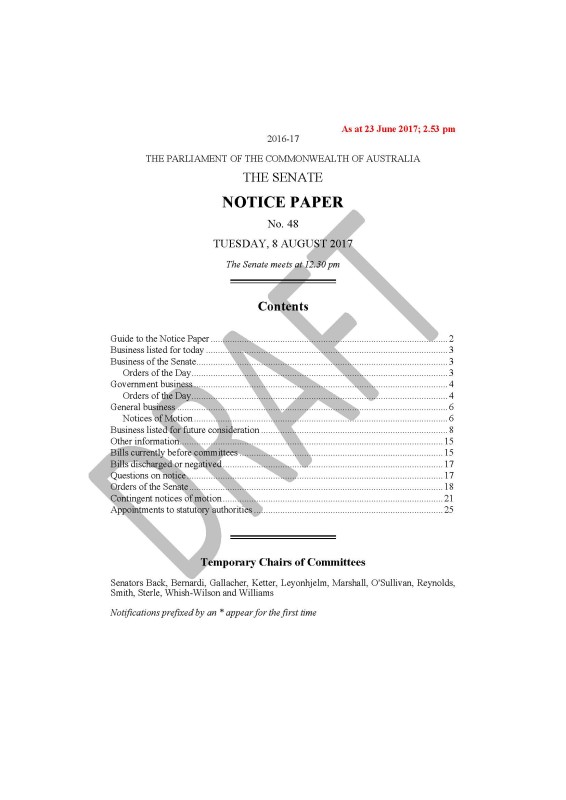
Senate Notice Paper
Parliamentary Education Office (peo.gov.au)
Senate Notice Paper
Parliamentary Education Office (peo.gov.au)
Description
A copy of the first page of the Senate Notice Paper – the schedule of what is going to be discussed in the Senate during a sitting day.

This work is licensed under a Creative Commons Attribution-NonCommercial-NoDerivatives 4.0 International License.
You are free to share – copy and redistribute the material in any medium or format.
The licensor cannot revoke these freedoms as long as you follow the license terms.
Attribution – You must give appropriate credit, provide a link to the license, and indicate if changes were made. You may do so in any reasonable manner, but not in any way that suggests the licensor endorses you or your use.
Non-commercial – You may not use the material for commercial purposes.
No derivatives – If you remix, transform, or build upon the material, you may not distribute the modified material.
No additional restrictions – You may not apply legal terms or technological measures that legally restrict others from doing anything the license permits.
Waiver – any of the above conditions can be waived if you get permission from the copyright holder.
This is a great question, thank you Sarah.
You can find out what the Parliament plans to discuss in each sitting – meeting – by checking a document called the Notice Paper. The Notice Paper is published online for both the Senate and the House of Representatives.
The Notice Paper sets out the daily schedule so senators and members of the House of Representatives know what is going to be discussed. Because the Notice Paper is publicly available, anyone can use it to see what issues are likely to be discussed when Parliament meets:
- The Senate Notice Paper is published on the Australian Parliament House website a day in advance.
- The House of Representatives Notice Paper is published close to when the sitting day commences.
The plan for what the Senate or House of Representatives will consider can be changed quickly to respond to national or international events. This means there is no single, long‑term schedule showing everything that will be discussed far in advance.