How did the drafters of the Australian Constitution decide how to divide powers between the federal Parliament and state parliaments?
Thanks for your question, Ella.
Because Australia is a federation, the federal Parliament shares law-making power with the 6 state parliaments. Decisions about how to divide this power were made at a series of conventions or meetings held to draft the Australian Constitution ahead of federation in 1901. At these meetings, representatives from the different colonies discussed what powers they wanted to keep and what they were willing to transfer to the new federal Parliament.
Most of these representatives were members of the colonial parliaments, which after 1901 became states in the federation. Before federation, the colonies acted like 6 separate countries with their own laws and small defence forces. Each colony even charged taxes on goods imported from the other 5 colonies.
The drafters of the Constitution recognised the need for a federal Parliament to deal with issues that affected the whole nation such as immigration, defence and currency. Most of these powers are listed section 51 of the Constitution.
The drafters also wanted to keep the power to make laws about issues that affected their individual states. Areas not listed in section 51 of the Constitution are the responsibility of state parliaments. These state issues include hospitals, police and roads.
Some of the federal Parliament’s law-making powers are exclusive, meaning that only it can make laws in this area. Other law-making powers are concurrent, meaning that both the federal Parliament and state parliaments can make laws in these areas. The drafters realised this overlap could cause problems so included section 109 in the Constitution. This section says that a federal law may override a state law if there is a conflict between the two.
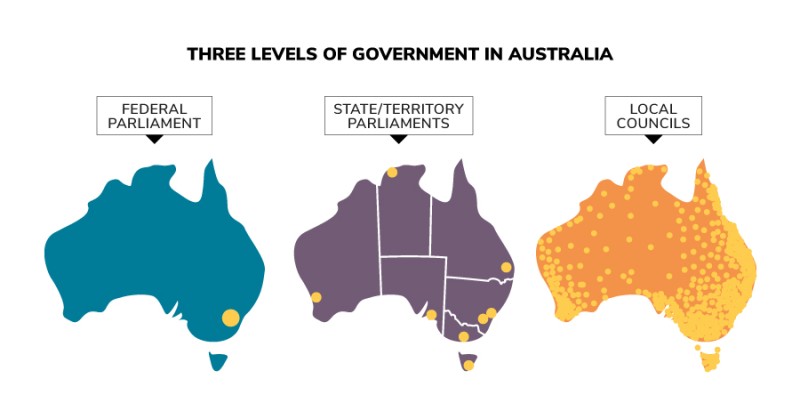
Three levels of government in Australia
Parliamentary Education Office (peo.gov.au)
Three levels of government in Australia
Parliamentary Education Office (peo.gov.au)
Description
The three levels of government – the law-making bodies in Australia. The Federal Parliament is located in Canberra, the nation's capital. State/territory parliaments are located in the capital cities of each of the 6 states and 2 territories. Local councils are located around Australia in each local council division.

This work is licensed under a Creative Commons Attribution-NonCommercial-NoDerivatives 4.0 International License.
You are free to share – copy and redistribute the material in any medium or format.
The licensor cannot revoke these freedoms as long as you follow the license terms.
Attribution – You must give appropriate credit, provide a link to the license, and indicate if changes were made. You may do so in any reasonable manner, but not in any way that suggests the licensor endorses you or your use.
Non-commercial – You may not use the material for commercial purposes.
No derivatives – If you remix, transform, or build upon the material, you may not distribute the modified material.
No additional restrictions – You may not apply legal terms or technological measures that legally restrict others from doing anything the license permits.
Waiver – any of the above conditions can be waived if you get permission from the copyright holder.