How are voters' preferences distributed if they vote above the line?
In a Senate election, voters can choose to vote ‘above the line’ by numbering at least 6 parties or groups in order of preference. When a voter numbers a party or group above the line, their preferences are distributed to that party or group’s candidates first, in the order they are listed below the line.
If their vote is transferred during the count, it continues through all the candidates in their most preferred party or group. It may then be transferred to the candidates in their next preferred party or group, again in the order they are listed below the line.
If a voter doesn’t agree with this order, they can vote ‘below the line’ instead by numbering individual candidates in their own preferred order.
Political parties can recommend an order of preferences (called a ‘how‑to‑vote’ card), but voters decide their own preferences when they number the boxes.
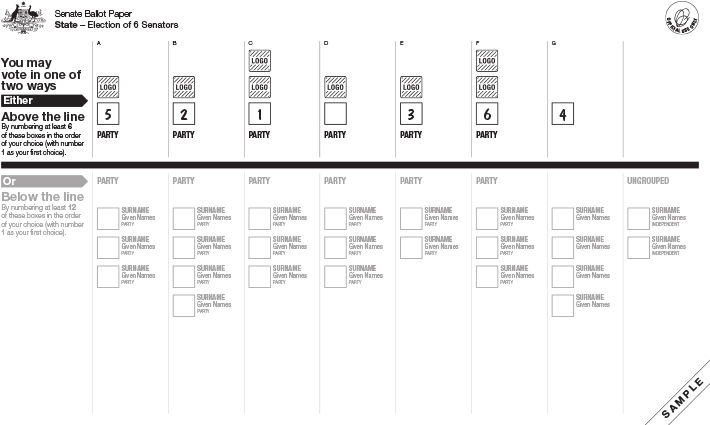
Sample Senate ballot paper – voting above the line
Australian Electoral Commission
Sample Senate ballot paper – voting above the line
Australian Electoral Commission
Description
This image is of a sample Senate ballot paper showing how to cast a valid vote above the line. There is a printed black horizontal line through the ballot paper. There are 7 boxes with 'Party' written above the line. These boxes have been numbered 1 to 6, one box has been left blank. There are many boxes with 'Surname, Given names, party' written below the line. All the boxes below the line have been left blank.
Permission should be sought from the Australian Electoral Commission (AEC) for third-party or commercial uses of this image. To contact the AEC email: media@aec.gov.au or phone: 13 23 26.