Has there ever been years when Parliament could not hold meetings? What happened?
There have been times when Parliament has limited the number of meetings in a year, but never a time when Parliament didn’t meet at all.
Section 6 of the Australian Constitution says that the Parliament must meet at least once a year. In practice, Parliament needs to meet several times a year so it can make decisions for Australia and to pass appropriation bills – laws that allow the government to spend money.
An example of where Parliament limited its meetings was during the Covid-19 pandemic in 2020. The Parliament decided to change its schedule and postpone some meetings of the Senate and House of Representatives. In 2020, the Senate met for a total of 46 days and the House of Representatives met for a total of 58 days. There were fewer senators and members attending these meetings than usual. On average, the Senate and House usually meet for 67 days, and most senators and members attend.
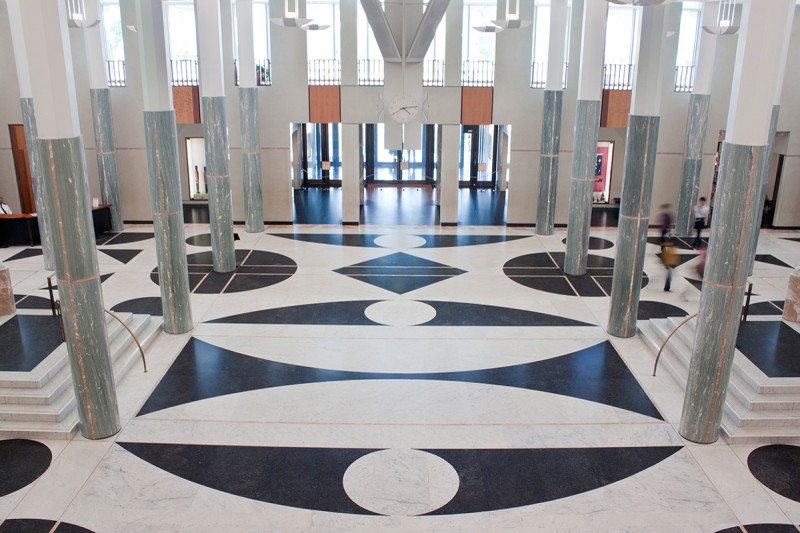
The Marble Foyer, Australian Parliament House
Parliamentary Education Office (peo.gov.au)
The Marble Foyer, Australian Parliament House
Parliamentary Education Office (peo.gov.au)
Description
The Foyer of Australian Parliament House is the main public entrance into the building. It serves as a gathering and orientation space for visitors including school groups, tourists, and official guests. It features floors made of black and white marble in a geometric pattern of circles, triangles and squares. There are also several tall green marble columns spaced evenly throughout the Foyer.

This work is licensed under a Creative Commons Attribution-NonCommercial-NoDerivatives 4.0 International License.
You are free to share – copy and redistribute the material in any medium or format.
The licensor cannot revoke these freedoms as long as you follow the license terms.
Attribution – You must give appropriate credit, provide a link to the license, and indicate if changes were made. You may do so in any reasonable manner, but not in any way that suggests the licensor endorses you or your use.
Non-commercial – You may not use the material for commercial purposes.
No derivatives – If you remix, transform, or build upon the material, you may not distribute the modified material.
No additional restrictions – You may not apply legal terms or technological measures that legally restrict others from doing anything the license permits.
Waiver – any of the above conditions can be waived if you get permission from the copyright holder.