Can the opposition or crossbench introduce bills in Parliament?
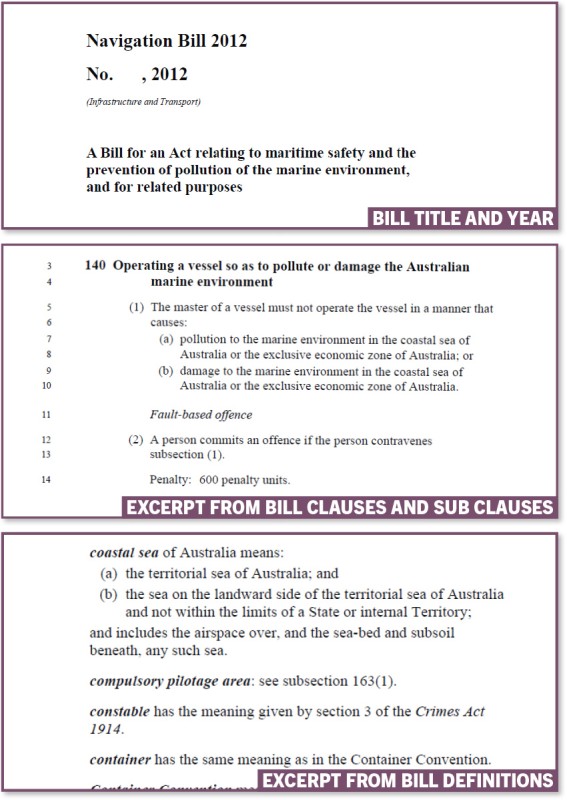
Parts of a bill
Parliamentary Education Office (peo.gov.au)
Parts of a bill
Parliamentary Education Office (peo.gov.au)
Description
The different sections of a bill – The top third shows the bill title and year, the middle third shows an excerpt from bill clauses and sub-clauses, the bottom third shows excerpts from bill definitions.

This work is licensed under a Creative Commons Attribution-NonCommercial-NoDerivs 3.0 Unported License.
You are free to share – to copy, distribute and transmit the work.
Attribution – you must attribute the work in the manner specified by the author or licensor (but not in any way that suggests that they endorse you or your use of the work).
Non-commercial – you may not use this work for commercial purposes.
No derivative works – you may not alter, transform, or build upon this work.
Waiver – any of the above conditions can be waived if you get permission from the copyright holder.
Hi Maxim, thanks for your question.
Yes. While most bills – proposed laws – are introduced by government ministers, other members of parliament, including the opposition, minor party members, independents and even government backbenchers, can introduce their bills. They are called private members' or private senators' bills.
Since Federation in 1901, only about 30 private bills have passed the Parliament. This is partly because the Senate and House of Representatives spend most of their time considering government business, meaning there is less opportunity to debate private bills. Also, the government usually has the majority in the House of Representatives, so a private bill will only succeed if the government supports it.
By introducing a private bill, a member of parliament can highlight and encourage debate on an issue or problem. Sometimes this prompts the government to introduce a similar bill. For example, the Sydney Airport Curfew Act 1995 is based on a bill introduced by the opposition following complaints from Sydney residents living under flight paths.
Sometimes members of parliament from different parties will work together to introduce private bills. An example of this was the Marriage Amendment (Definition and Religious Freedoms) Bill 2017, which legalised same‑sex marriage in Australia. It was co-sponsored by senators from 3 different parties – the government, opposition and crossbench.