Can state laws change federal laws in Australia?
Hi Craige, thanks for your question.
No, state laws cannot change federal (national) laws in Australia.
Under the Australian Constitution, both the federal and state parliaments have law-making powers. The Constitution lists the areas about which the federal parliament can make laws – for example immigration, defence, currency and trade. Other areas are the responsibility of the states. States cannot change or override laws for which the federal Parliament is responsible, because the Constitution does not give them that power.
If a law is contested – challenged – it is up to the High Court of Australia to decide whether the Constitution gives the state parliament or federal Parliament the power to make the law, and therefore which law will apply.
On some matters, the federal Parliament and the state parliaments may make laws about the same things, for example, roads and health. When both the federal and state parliaments can make laws about the same area, section 109 of the Constitution applies. It says that if a state law is inconsistent with a valid federal law, the federal law will apply and the inconsistent part of the state law will have no effect.
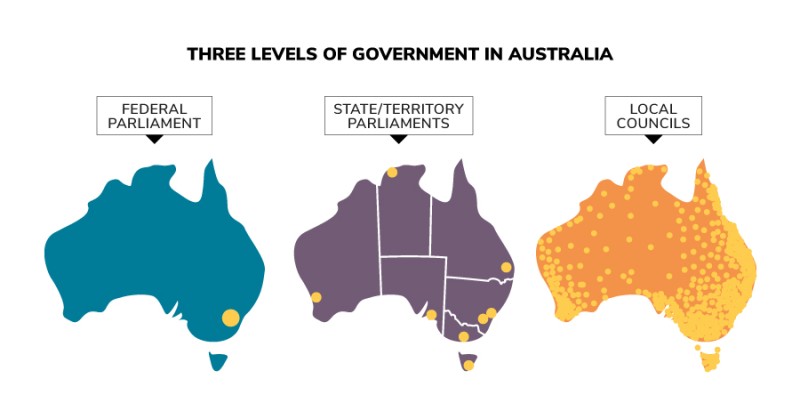
Three levels of government in Australia
Parliamentary Education Office (peo.gov.au)
Three levels of government in Australia
Parliamentary Education Office (peo.gov.au)
Description
The three levels of government – the law-making bodies in Australia. The Federal Parliament is located in Canberra, the nation's capital. State/territory parliaments are located in the capital cities of each of the 6 states and 2 territories. Local councils are located around Australia in each local council division.

This work is licensed under a Creative Commons Attribution-NonCommercial-NoDerivatives 4.0 International License.
You are free to share – copy and redistribute the material in any medium or format.
The licensor cannot revoke these freedoms as long as you follow the license terms.
Attribution – You must give appropriate credit, provide a link to the license, and indicate if changes were made. You may do so in any reasonable manner, but not in any way that suggests the licensor endorses you or your use.
Non-commercial – You may not use the material for commercial purposes.
No derivatives – If you remix, transform, or build upon the material, you may not distribute the modified material.
No additional restrictions – You may not apply legal terms or technological measures that legally restrict others from doing anything the license permits.
Waiver – any of the above conditions can be waived if you get permission from the copyright holder.