interactive
Federal, state and local
Do you know what each level of government is responsible for? Test your knowledge of the three levels of government in Australia with this game.
Begin your exploration of the three levels of government in Australia with this short introduction. Discover the responsibilities of the federal Parliament, state and territory parliaments and local government, and how they work together.
Australia has three levels of government that work together to provide us with the services we need.
The three levels of government are:
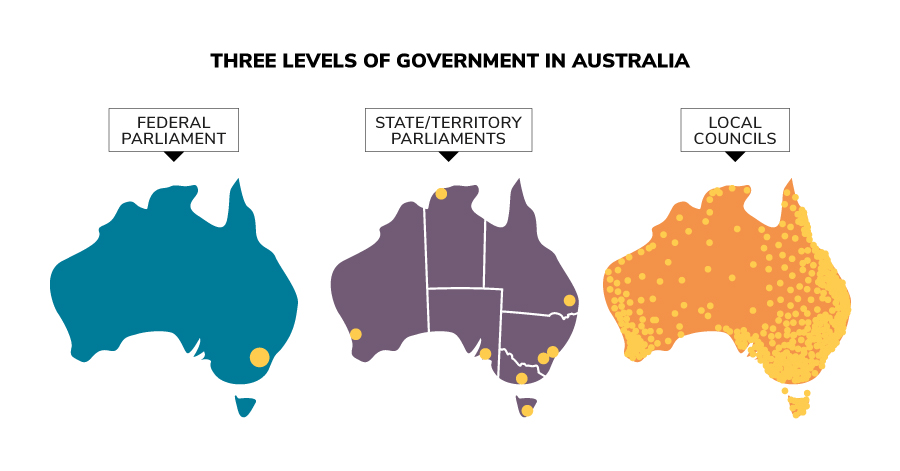
Three levels of government in Australia
Parliamentary Education Office (peo.gov.au)
Parliamentary Education Office (peo.gov.au)
The three levels of government – the law-making bodies in Australia. The Federal Parliament is located in Canberra, the nation's capital. State/territory parliaments are located in the capital cities of each of the 6 states and 2 territories. Local councils are located around Australia in each local council division.

This work is licensed under a Creative Commons Attribution-NonCommercial-NoDerivatives 4.0 International License.
You are free to share – copy and redistribute the material in any medium or format.
The licensor cannot revoke these freedoms as long as you follow the license terms.
Attribution – You must give appropriate credit, provide a link to the license, and indicate if changes were made. You may do so in any reasonable manner, but not in any way that suggests the licensor endorses you or your use.
Non-commercial – You may not use the material for commercial purposes.
No derivatives – If you remix, transform, or build upon the material, you may not distribute the modified material.
No additional restrictions – You may not apply legal terms or technological measures that legally restrict others from doing anything the license permits.
Waiver – any of the above conditions can be waived if you get permission from the copyright holder.
Each level of government has the power to make laws about different things. Sometimes these powers are shared.
FEDERAL PARLIAMENT |
STATE AND TERRITORY PARLIAMENTS |
LOCAL COUNCILS |
|
Responsible for issues that affect all Australians (national issues) |
Responsible for issues that affect people in that state or territory |
Responsible for issues that affect local communities |
|
Post, telephones and the internet Immigration Defence |
Police Public transport Hospitals |
Rubbish collection and recycling Parks, sports fields and swimming pools Pet control |
The law-making powers of the federal Parliament Parliamentary Education Office (peo.gov.au) Parliamentary Education Office (peo.gov.au) The law-making powers of the federal Parliament include: This work is licensed under a Creative Commons Attribution-NonCommercial-NoDerivatives 4.0 International License. You are free to share – copy and redistribute the material in any medium or format. Attribution – You must give appropriate credit, provide a link to the license, and indicate if changes were made. You may do so in any reasonable manner, but not in any way that suggests the licensor endorses you or your use. Non-commercial – You may not use the material for commercial purposes. No derivatives – If you remix, transform, or build upon the material, you may not distribute the modified material. Waiver – any of the above conditions can be waived if you get permission from the copyright holder.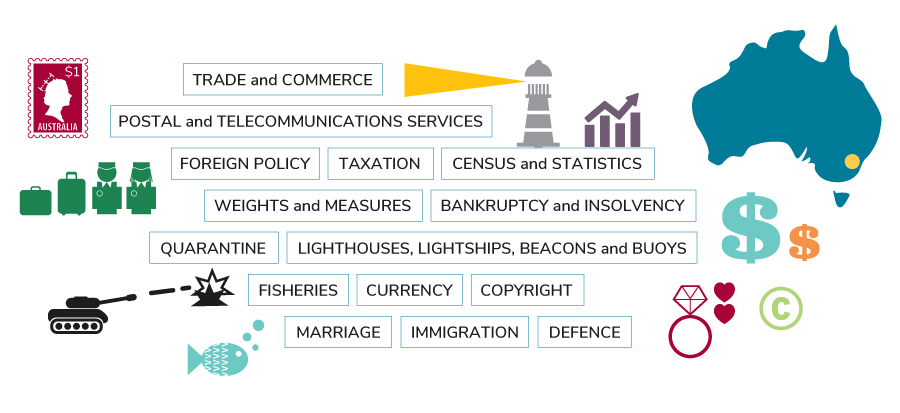
The law-making powers of the federal Parliament
Description
Copyright information
The licensor cannot revoke these freedoms as long as you follow the license terms.
No additional restrictions – You may not apply legal terms or technological measures that legally restrict others from doing anything the license permits.
Did you know?
In the Australian Capital Territory (ACT) there are only 2 levels of government! The ACT Government has the roles and responsibilities of both a state government and a local government. This means the ACT Government runs hospitals, schools and prisons, as well as controlling parking, collecting rubbish and running libraries.
Curriculum alignment
Year 4 AC9HS4K08
Year 6 AC9HS6K07
Year 7 AC9HC7K01
Year 9 AC9HC9K02