Crossing the floor
‘Crossing the floor’ is when a member of a parliamentary party votes against their party. This fact sheet explores why this happens and the potential consequences.
What will I learn?
- 'Crossing the floor’ is when a member of parliament votes against their own team.
- Crossing the floor is rare and usually only happens after careful consideration.
- A ‘free vote’ is when members of parliament vote according to their own beliefs, rather than as a team.
What is crossing the floor?
When the Senate or House of Representatives needs to make a decision, a vote is taken. Members of parliamentary parties usually vote as a team in Parliament, with all party members voting the same way.
Crossing the floor is when a member of parliament votes against the rest of their party during a division – a formal vote. Members of parliament sit on the right of the Presiding Officer to vote ‘yes’ and to the left to vote ‘no’ during a division. If a member of a political party decides to vote differently to rest of their party, they walk across or ‘cross’ the floor to sit opposite the other members of their team.
Deciding to cross the floor
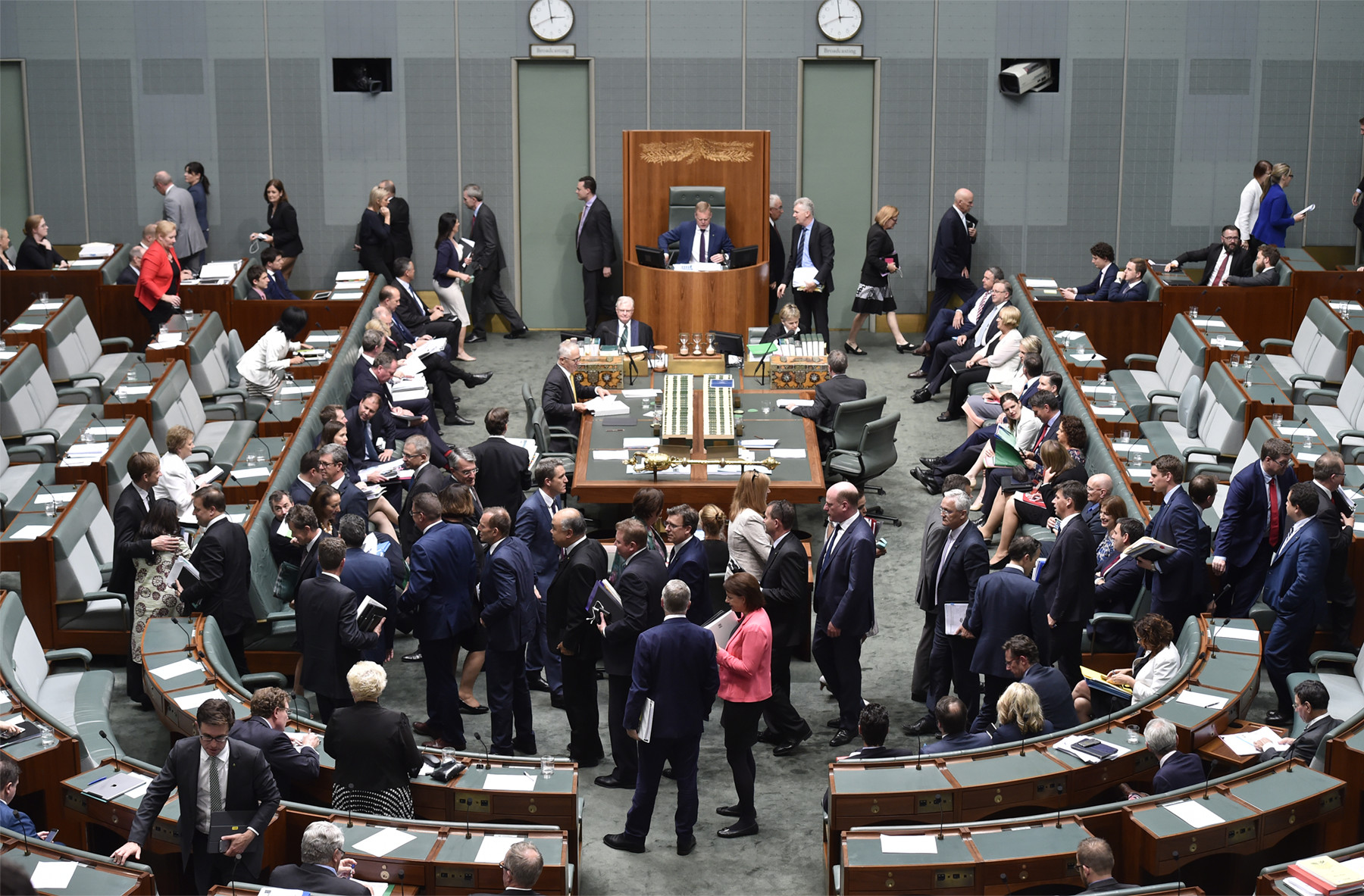
The House of Representatives during a division
DPS AUSPIC
The House of Representatives during a division
DPS AUSPIC
Description
A formal vote called a division happening in the House of Representatives. Members are dividing into two groups. Those voting 'aye' or 'yes' are moving to sit on one side of the House and on those voting 'no' are moving to sit on the other side.
Copyright information
Permission should be sought from DPS AUSPIC for third-party or commercial uses of this image. To contact DPS AUSPIC email: auspic@aph.gov.au or phone: 02 6277 3342.
- members of parliament are likely to have joined their party because they agree with party policies and voters expect them to support these policies in Parliament
- parties often have rules about voting as a team. Crossing the floor may affect the support or opportunities a member receives within their party and can even lead to the member being suspended or removed from their party
- working together gives members more power than acting alone
- crossing the floor may not change the result unless enough members do it together. Without enough support, crossing the floor may be a controversial act that makes no difference to the result.
A member of parliament may still choose to cross the floor. This might be because:
- they strongly agree or disagree with a particular policy or decision
- they believe a different outcome would be better for the people in their state, territory or electorate
- the issue is a matter of personal values or conscience.
For these reasons, crossing the floor is usually a serious and carefully considered decision.
If a party or coalition of parties has a small majority of only one or two votes, it becomes even more important for team members to stick together. Party whips – team managers – are responsible for making sure party members know how to vote and are not planning to cross the floor.
Free vote
In a free vote – sometimes called a conscience vote – members of parliament are not required to vote with their party. Free votes have mostly been used to decide issues such as euthanasia, stem cell research or same-sex marriage.
Each parliamentary party decides when its members are allowed a free vote. Parties may allow a free vote to avoid team members crossing the floor, or to allow members of parliament to express their own beliefs.
Free votes are rare. Between 1950 and 2021, only 43 votes on bills and other issues in the Parliament were decided by a free vote.
History
Although crossing the floor is rare now, it happened more often in the past. From 1950 to 2019, there were 295 members of parliament who crossed the floor, representing 23% of all members of parliament who served in this period. Only 12% of divisions were affected by these floor crossings. Tasmanian Senator Reg Wright, who served from 1950 to 1978, crossed the floor 150 times. This is the most times any member of parliament has done so.