What happens if a member of parliament is late to a vote?
If a member of parliament is late to a division their vote will not be counted.
Decisions are made in the Australian Parliament by voting on a question. Although senators and members of the House of Representatives don’t have to be present during all the debate, it is expected that they will be present for formal votes – divisions.
When a division is called, the Clerk rings the division bells for 4 minutes to request senators or members return to vote. If more than one division is held in quick succession, members have only 1 minute to return. When the bells stop ringing, the doors are closed and locked, and members of parliament are not allowed to enter or leave the room until the end of the division. The doors are locked so there is no confusion during the count caused by senators or members entering or leaving the room. Sometimes, a senator or member may be late and the doors are locked before they arrive. Those who are in the room are counted and those who are locked out are not counted.
Being late can have consequences. Party whips expect party members to attend divisions, so being late may lead to discipline within the party. Voters may also notice if their representative regularly misses votes.
In the House of Representatives a member may ask ‘that the House divide again’. If this is agreed to, the vote is retaken and the result of the new division is recorded as the decision of the House. The Senate also allows another division for ‘errors, confusion or misadventure in divisions’.
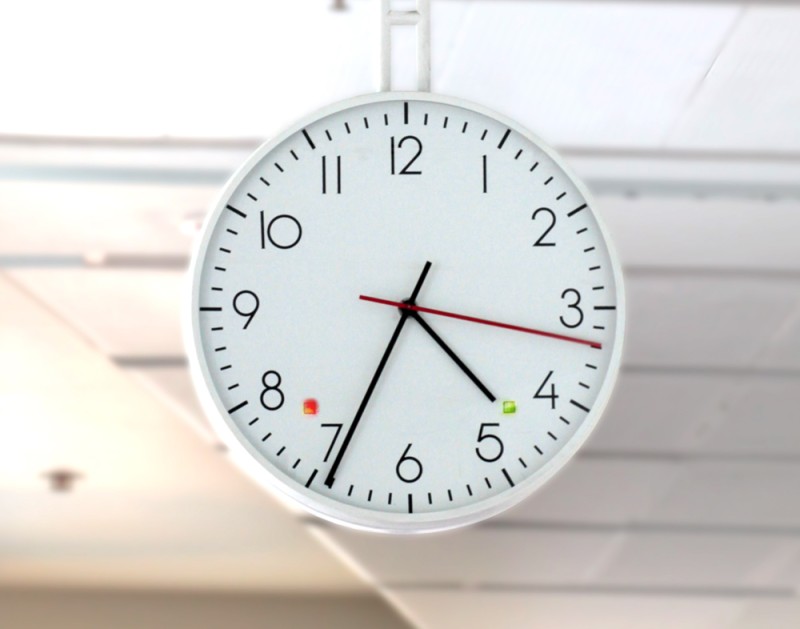
A clock at Parliament House
Parliamentary Education Office (peo.gov.au)
A clock at Parliament House
Parliamentary Education Office (peo.gov.au)
Description
The clocks at Australian Parliament House have red and green lights that indicate that the Senate or the House of Representatives bells are ringing. This happens to let senators and members of the House know when a vote is about to happen.

This work is licensed under a Creative Commons Attribution-NonCommercial-NoDerivatives 4.0 International License.
You are free to share – copy and redistribute the material in any medium or format.
The licensor cannot revoke these freedoms as long as you follow the license terms.
Attribution – You must give appropriate credit, provide a link to the license, and indicate if changes were made. You may do so in any reasonable manner, but not in any way that suggests the licensor endorses you or your use.
Non-commercial – You may not use the material for commercial purposes.
No derivatives – If you remix, transform, or build upon the material, you may not distribute the modified material.
No additional restrictions – You may not apply legal terms or technological measures that legally restrict others from doing anything the license permits.
Waiver – any of the above conditions can be waived if you get permission from the copyright holder.