Curriculum links – Year 6
The PEO has a range of resources to assist teachers in their delivery of the content descriptions for the Civics and Citizenship subject of the Year 6 HASS learning area in the Australian Curriculum V9.0.
Individual curriculum linked resources
-
AC9HS6K06
-
The key institutions of Australia’s system of government, how it is based on the Westminster system, and the key values and beliefs of Western democracies.
-
Parliament House program
Join in the fun – and the learning – with the PEO's immersive learning program at Australia's Parliament House in Canberra. This free program is suitable for primary and secondary students.
-
Parliament House
This fact sheet explores the building where the Australian Parliament meets. Discover key facts about the building and the symbolism of its design.
Fact sheet
-
Government
This fact sheet explores the responsibilities of the Australian Government, how it is formed, minority government and the principle of responsible government.
Fact sheet
-
Magna Carta
This fact sheet explores the Magna Carta – the ‘Great Charter’. It includes information about the history of the Magna Carta and its importance in the development of democracy and human rights.
Fact sheet
-
Separation of powers
The power to make and change Australian law is divided between 3 groups
-
House of Representatives
This fact sheet explores the House of Representatives, which is part of the Australian Parliament. It includes information about the role, appearance and origins of the House of Representatives.
Fact sheet
-
Senate
This fact sheet explores the Senate, which is part of the Australian Parliament. It includes information about the role, appearance and origins of the Senate.
Fact sheet
-
Introducing ... Australia's system of government
Begin your exploration of the features of Australia’s system of government with this short introduction. Discover how power is shared and managed between different groups in Australia.
introducing
-
Australian Constitution
This fact sheet explores the Australian Constitution. It includes information about the key features of the Constitution and how it can be changed.
Fact sheet
-
Three levels of government
Three different elected groups are responsible for making laws in Australia
-
Australian Parliament
This fact sheet outlines the composition and role of the Australian Parliament.
Fact sheet
-
A short history of Parliament
This in-depth paper explores the development of the Westminster system in Britain and parliamentary democracy in Australia.
inFocus
-
Australia's Parliament House
This in-depth look at Australia's Parliament House investigates why Canberra was chosen to be the nation's capital and why we needed a 'new' Parliament House. It includes the design, site and symbolism of the building.
inFocus
-
Self-paced interactive learning
Whether you're new to teaching civics, a seasoned educator, a pre-service teacher, or a curriculum leader – our free, self-paced, interactive courses are designed for you.
-
Make a law: House of Representatives
Discover how bills ─ proposed laws – are introduced, debated and voted on in the House of Representatives by turning your class into a Parliament and doing it yourselves.
Classroom activity page
-
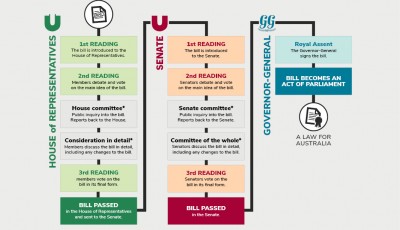
Law-making
This fact sheet explains the law-making process in the Australian Parliament. It also describes where ideas for laws come from and the history of law-making in the Parliament.
Fact sheet
-
Prime Minister
Understand the role of the Prime Minister with this fact sheet, including how the Prime Minister is chosen and their responsibilities.
Fact sheet
-
The Australian Parliament
-
Make a law: Senate
Discover how bills – proposed laws – are introduced, debated and voted on in the Senate by turning your class into a Parliament and doing it yourselves!
Classroom activity page
-
Year 6
This unit of work explores 4 topics aligned to the Year 6 Australian Civics and Citizenship Curriculum.
Classroom activity page
-
The Senate
-
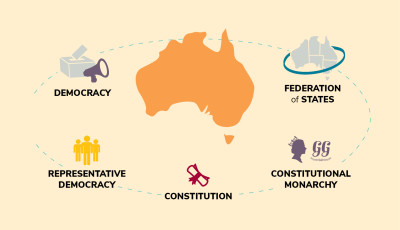
Australian system of government
This fact sheet examines Australia’s system of government. It includes information about representative democracy, constitutional monarchy, federation and the separation of powers.
Fact sheet
-
Canberra from above
Discover where Australian Parliament House sits within the capital city of Australia, Canberra.
video
-
Professional learning
The Parliamentary Education Office provides professional learning for teachers and pre-service teachers. Our programs are free and align with the Australian Curriculum V9.0. We support teachers to deliver informative and engaging parliamentary and civics and citizenship curriculum for their students.
-
Run a Cabinet meeting
Investigate how Cabinet makes decisions by working together to negotiate the best policy outcome.
Classroom activity page
-
Democracy
This fact sheet introduces the idea of democracy and explores the key ideas which support Australia’s democratic system of government.
Fact sheet
-
Cabinet
Find out more about who is in Cabinet and how it works with this fact sheet.
Fact sheet
-
Choosing senators
Senators represent their state or territory in the Senate
-
The Australian Constitution in focus
This paper explores in detail the history of the Constitution and its key features.
inFocus
-
Run a parliamentary committee
Explore how individuals and communities can assist the Australian Parliament to investigate bills and important issues by running a parliamentary committee with your class.
Classroom activity page
-
Governor-General
The Governor-General has an important role in the governing of Australia. This fact sheet looks at the constitutional, ceremonial and civic roles of the Governor-General.
Fact sheet
-
The House of Representatives
-
Choosing members
Members represent their electorate in the House of Representatives
-
Forming the Australian government
The Australian Government is formed after a federal election
-
Making Australian law
-
Amendments
An amendment is a change to a proposed law. Amendments are an important part of the law-making process in the Australian Parliament. This fact sheet outlines the amendment process.
Fact sheet
-
Separation of powers: Parliament, Executive and Judiciary
The separation of powers distributes the power to govern between the Parliament, the Executive and the Judiciary. This fact sheet examines the powers of each group and the related principle of responsible government.
Fact sheet
-
Separation of powers
Test your knowledge of the separation of powers—an important principle of Australia's democracy—with this fun quiz.
quiz
-
The monarch
This fact sheet explains the role of the monarch in the Australian Parliament. Find out why Australia has the King as our head of state and what power the King has in Australia.
Fact sheet
-
Knowledge check: the Governor-General
How much do you know about the role of Governor-General? Test your knowledge with this fun short quiz.
quiz
-
Leader of the Opposition
Get to know the role of the Leader of the Opposition with this fact sheet.
Fact sheet
-
-
AC9HS6K07
-
The roles and responsibilities of the 3 levels of government in Australia.
-
Parliament House program
Join in the fun – and the learning – with the PEO's immersive learning program at Australia's Parliament House in Canberra. This free program is suitable for primary and secondary students.
-
Introducing ... the three levels of government
Begin your exploration of the three levels of government in Australia with this short introduction. Discover the responsibilities of the federal Parliament, state and territory parliaments and local government, and how they work together.
introducing
-
Federal, state and local
Do you know what each level of government is responsible for? Test your knowledge of the three levels of government in Australia with this game.
interactive
-
Three levels of government
Three different elected groups are responsible for making laws in Australia
-
The responsibilities of the three levels of government
This fact sheet introduces the three levels of government in Australia and lists some of the responsibilities of each level.
Fact sheet
-
Self-paced interactive learning
Whether you're new to teaching civics, a seasoned educator, a pre-service teacher, or a curriculum leader – our free, self-paced, interactive courses are designed for you.
-
Three levels of government
Get an introduction to the three levels of government with this short video. It explores the areas each level can make laws about.
video
-
Year 6
This unit of work explores 4 topics aligned to the Year 6 Australian Civics and Citizenship Curriculum.
Classroom activity page
-
How governments in Australia raise and spend money
This graphic illustrates the how the three different levels of government get their income and what they spend it on.
image
-
Levels of government
In Australia 3 superheroes fight for the people. Discover their powers and those of the three levels of government with this video from the ABC’s Behind the News.
video
-
Explore the three levels of government
Explore the three levels of government—federal, state, and local—with this classroom activity. Investigate the responsibilities of each level by forming taskforces to respond to major events.
Classroom activity page
-
Three levels of government: governing Australia
This in-depth paper explores the roles and responsibilities of each level, how they raise money and how they work together.
inFocus
-
Three levels of government quiz
Learn more about the three levels of government with this quiz.
quiz
-
Discover more Year 6 curriculum-aligned resources

Source information
Australian Curriculum, Assessment and Reporting Authority (ACARA) Version 9.0 Home | V9 Australian Curriculum.
Last accessed January 2026.
All material identified by "AC" is licensed under a Creative Commons Attribution-NonCommercial-ShareAlike 3.0 Australia (CC BY NC SA) licence. For all material licensed under this creative commons licence, you are free to:
- Share – copy and redistribute the material in any medium or format; and
- Adapt – remix, transform, and build upon the material,
under the following terms:
- Attribution – You must give appropriate credit, provide a link to the license, and indicate if changes were made. You may do so in any reasonable manner, but not in any way that suggests the licensor endorses you or your use.
- Non-Commercial – You may not use the material for commercial purposes.
- ShareAlike – If you remix, transform, or build upon the material, you must distribute your contributions under the same license as the original.